|
Revision: 11 July 2007
|
|
EVANS CEMETERY, LOCATED ABOUT ONE MILE IN REAR OF THE HOME OF MR. LEROY EVANS AND ABOUT TWO MILES WEST OF PROVIDENCE CHURCH ON HIGHWAY TO ORANGEBURG, SC
SAMUEL FOXWORTH, son of A. C. & M. A. EDWARDS, b. Sep 20,1855; d. Aug 3,1856
MISS ELIZA, dau. of John & Margaret EVANS, b. Dec 5,1809; d. Jun 29,1872
FRANCES S. EVANS, b. April 27,1820; d. October 2,1892
DAVID W. EVANS, b. July 13,1823; d. February 28,1900
OLIN DANTZLER, son of D. W.& F. E. EVANS, b. July 26,1855; d. July 1,1856
DANIEL E. DANTZLER, b. Nov 1,1893; d. February 8,1895
ATTICUS HAYGOOD EVANS, b. May 3,1896; d. December 24.1896
JACOB ELLIOTT EVANS, b. April 15,1898; d. November 12,1900
SUSIE MAE, dau. of D. L. EVANS, b. Sep.11, 1905; d. Oct.25,1906
HUGH WALKER, son of L. R.& M. A. EVANS, b.Oct.29, 1873; d. Feb. 8,1874
MARY A., wife of L. R. EVANS, b.Nov.27,1851; d. June 9,1914
LEWIS R. EVANS, b. May 12,1845; d. October 16,1934
WADE EVANS, b. October 4,1807; d. September 30,1897
ELIZABETH D., wife of Wade EVANS, b. November 30,1835; d. November 3,1878
MARY E. EVANS, b. August 29,1832; d. December 31,1919
ROBERT HALL, son of Wade & Sarah EVANS, b. March 31,1849; d.Jan.21 1831
JOHN EDWIN EVANS,Co.G.13 Ga. Inf., C.S.A.
JULIUS W. EVANS, Co. G. Ga. Inf., C.S.A.
GEORGE WASHINGTON, son of Wade & Sarah EVANS, b.Dec.22,1832; d. Nov.23,1847
WALTER WADE, son of Roland & Charlotte EVANS, d.Feb.17,1857,aged 2 yrs. & 2 Mos.
SARAH ANN HALL, wife of WADE EVANS, b. Sept.11,1810; d. May 21,1865
INFANT DAUGHTER of Wade & Sarah EVANS, d.Sept.25,1847; aged 11 hours
GEORGE V. BAIR, b. November 13,1868; d. June 8,1903.
J. W. Joyner &, H.H. Cawley, July 13, 1957.
|
|
|
|
|
|
ACKNOWLEDGEMENTS
I gratefully acknowledge the responses to my numerous inquiries, without which I could not have put together even this inadequate history and genealogy of our branch of the Providence Evanses.
Elsewhere I shall give credit to some who shared with me the information they had on the early days. But I do want to give recognition here to Lottie Mae Evans, wife of Leroy Evans (deceased) and Margaret Evans, wife of Frank Evans (deceased) for giving me access to family Bibles. In these I found information I could have found nowhere else. Also, I am most grateful for the assistance of Hattie Lee Evans Shuler and her husband Wallace (now deceased) in leading me to the old Evans cemetery and Rowland�s marker. Wallace helped clean the stones at the cemetery so that we might read the inscriptions.
I am indebted to Frances Gordy Wroton, who, upon Jimmy Wroton�s suggestion, sent me a copy of the Camp Meeting picture. Also, special thanks to Terry Woodings for taking down the notes of the phonics tune as I attempted to sing it; and to Richard H. Hair, Jr. for beautifully printing the title of the booklet.
I must give credit to my sister, Evangeline Dantzler Robinson, for her invaluable assistance in placing events of the past in the proper perspective and critically reading my manuscript; to my sister Elizabeth (Betsy) Dantzler Spiers for her repeated assistance in making contacts with persons who could give me data for the genealogy; to my three daughters who either personally did research or paid to have it done; and lastly, but importantly, to my long-suffering husband for his understanding as I dealt with the many frustrations of my undertaking.
|
|
TABLE OF CONTENTS
THE PREFACE
A SHORT SKETCH OF THE EARLY HISTORY OF THE EVANS FAMILY HARRIET EVANS BULL
A TRIBUTE TO JOHN EVANS JOHN W. KELLEY
FRAGMENTS OF THE EVANS CLAN BACKGROUND JIMMY WROTON, SR
MORE ABOUT GREAT‑AUNT LEAH
THE FAMILY BEFORE AND AFTER THE WAR BETWEEN THE STATES
GLIMPSES OF MY UNCLES, MY AUNTS, AND MY MOTHER
THE GENEALOGY
|
|
THE PREFACE
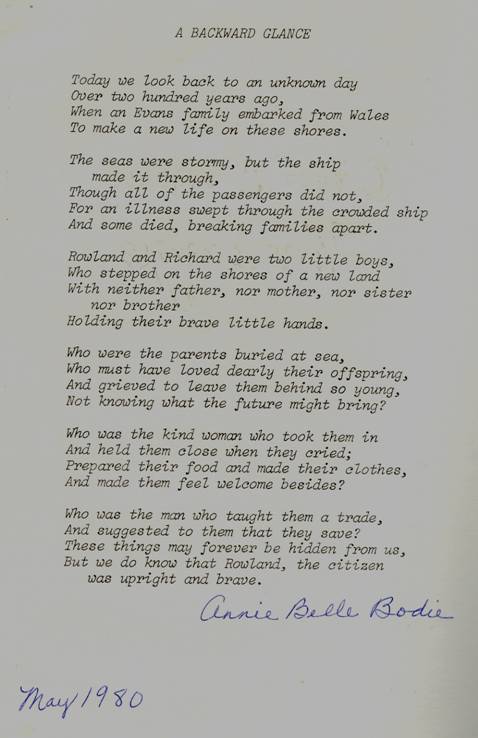
Feeling that my children had the right to know as much about their Evans heritage as their Dantzler‑Haigler heritage, I set out in the spring of 1977 to gather some information on the Evans family who settled in the Providence Community of what is now Orangeburg County, S. C.
My mother had often told me that the family came from Wales. I had in my possession a tribute to John Evans, her grandfather. copied from the Southern Christian Advocate which told of John's father, Rowland Evans, having been shot down in his own yard by a band of Tories a few days after the battle of Eutaw Springs, in which, he had engaged September 8. 1781.
I felt impelled to find out the name of Rowland's father, who, I presumed, was the �migr�, perhaps bringing the boy with him from Wales. .
My efforts in the fall of 1977 at the S. C. Archives were futile, and I found out why when I learned that the family did not land in Charleston as I had thought. The eye‑opener was "A Short Sketch of the Early History of the Evans Family", written by Harriet Evans Bull. This sketch was first sent to me by Louise Evans McCrorey. Practically the same material ‑ prepared for membership in the D.A.R. ‑ came to me from Ruth Evans Barrett. From It I learned that the surname of Rowland Evans' wife is "Day".
Hattie Lee Evans Shuler, sister of Louise McCrorey, sent a duplicate copy of the aforementioned sketch and with it a letter dated September 21. 1912 written by Harriet E. Bull to one named Lizzie, who was obviously a member of the D.A.R. Excerpts from this letter follow:
"There are some old land Grants still in possession of his (Rowland's) descendants, which were obtained from the Royal Governor, William Bull, some years prior' to the Revolution. It was upon this land that he was settled and was living at the time of the war and where he was also buried.
"A few years ago Fannie Pemberton wished to join the D.A.R. She applied to the State Librarian, Mrs. Sallye, to assist her in searching the state records. She finally discovered a bill for supplies for some of Marion's men, among whom was Rowland Evans.
"The grave (Rowland's) can be located, being on the land now owned by D. L. Evans. The descendants would be very glad to secure a monument for it. There would be no trouble in getting it set up.".
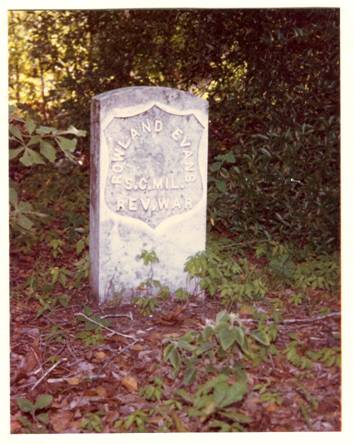
The small simple stone, which marks Rowland's grave, bears only the inscription: Rowland Evans, Rev. War.
D.A.R. Patriot List--1967, pp. 224-225.
Note 1. When at the S. C. Archives October 1977, I was searching for proof of the military rank of Rowland Evans. I was shown an order which neither the archivist nor I could satisfactorily read, but the name Captain Rowland Evans was distinct and so was the name of the signer General Francis Marion. The archivist assured me it was all the proof I needed that Rowland Evans' rank was captain. |
|
|
|
Original Document, Page #1)
A SHORT SKETCH OF THE EARLY HISTORY OF THE EVANS FAMILY
HARRIET EVANS BULL
About the year 1750, or possibly a few years earlier, a family from Wales by the name of Evans, consisting of father, mother, and two sons took passage on an emigrant ship bound for America.
During the long and tedious voyage typhus fever broke out among the passengers, and caused the death of both father and mother of this family.
On arriving at the port of Boston, the two little boys Rowland and Richard, being strangers and without protectors, were taken in charge by the city of Boston, and in due time were apprenticed to trades.
After reaching manhood, they came south and settled in the province of South Carolina. It is not certain where Richard located, but it is thought at Granby, as he was living there some time later. Rowland located in Charleston and there plied his trade as a painter. Granby was just across Congaree River from Columbia's present site.
Later, the King of England was making liberal grants of land, through the royal governor William Bull, in the interior of the province to settlers. Rowland Evans obtained one of these grants in what is now Orangeburg County. He sold out his interests in Charleston, bought a few negroes, settled on the land, and engaged in farming a few years prior to the Revolution.
During the time of the Revolution, when the country was overrun by British and Tories, Rowland Evans cast his lot with the Partisans, raised a little company and joined Marion's Brigade, doing valiant service for his country. He participated in the battle of Eutaw Springs in 1781, and, coming home a few days later to visit his family, was there shot down in his own yard by a party of four Tories.
The exact date of birth and death are not known, as it is said that the family records were destroyed by
|
|
(Original Document, Page #2)
fire sometime afterward. His grave is near the spot where he was killed, and has been marked by the U.S. Government.
Rowland I: He left four children: Rowland II, John, William, and "Polly". Rowland died young. John married Margaret Moorer, William married ???? Polly married Jacob Moorer.
The children of John Evans: Richard, Rowland, Wade, Lewis, Leah, Eliza, Elizabeth, Mary Ann, and David whose mother died at his birth in 1823. John Evans afterward married Mrs. Zimmerman.
Note 2. A genealogist researched the Boston records but could find no trace of the two little orphaned boys- nothing on the landing of the vessel on which they came, the names of their parents, or the place in Wales they left to come to America. All of us who are descended from Rowland Evans are indebted to Harriet Evans Bull for keeping this much of their story alive and passing it down to us .
Note 3. At the N. C. Archives, Raleigh, N.C., the following item of interest was found:
The Jury List (1778‑1779) compiled by the D.A.R. gives a list of Grand Jurors in which we find Rowland Evans under St. Matthew (Parish) Orangeburg District. (A genealogist assured us that the present Providence Community is the same area. )
Note 4. This interesting section from the 1790 Census, given me by a genealogist in Columbia, S. C. reveals John as the head of his father's family. (Rowland was killed in 1781 and son Rowland had no doubt died too.) Evans ‑ John
1 male over 16 (John was 19 then) 1 male under 16 (William was 14 ) 2 females (the mother and Polly) 4 slaves
|
|
(Original Document, Page #3)
A TRIBUTE TO JOHN EVANS
John W. Kelley
Father John Evans lived to almost four score and ten. He died in his 88th year. (1771-1859)
He had been for fifty years a class leader ‑ his official term beginning almost with his membership and terminating last year. For the greater part of this period he was the only leader in a large society. He lived in Orangeburg Dist., S.C., on the State Road, a short distance from Providence Church, now Cypress circuit. His father was an officer, commanding a company at Eutaw, and our departed friend often said he heard the roar of the cannons during that trying conflict. A few days after the battle his father came home on a furlough, and was shot down in his own yard by a band of Tories. The son, though but a lad, was only restrained by a negro from firing upon the murderers, and both were saved by, the servant's thoughtful prudence. He, however, vowed revenge and for many long years went constantly armed that he might, on the first occasion, have vengeance. It so happened that the first opportunity afforded was at camp‑meeting where, as was his custom, he was dispensing a generous hospitality. A stranger was passing ‑ he invited him to eat some melons at his tent and found in the worn and ill clad stranger, one of his father's murderers. To use his own words "The tiger was in me, my rifle was in my tent, my vow for revenge was recalled, and I remembered 'vengeance is mine ‑ I will repay, saith the Lord', and though it cost me a struggle, I gained the victory." He was now a member of the church and a converted man ‑ one renewed in the spirit of his mind-‑old things had passed away and all things were becoming new-‑and he thus evidenced what was obvious in after life, that, though naturally quick and resolute, religion exercised an abiding and controlling influence over his judgement and feelings. As was usual then ‑ and no less so now ‑ his earnest and decisive character made him a favorite with itinerant preachers and his house was their welcome retreat. It is a matter of pleasing reflection that this state of things will con�tinue as sons and sons‑in‑law inherit these with other of his many excellencies. He continued his active
|
|
(Original Document, Page #4)
habits in church going and visitations among his children and neighbors, till about a week before his death. He was taken ill on the 3rd of October last, and died on the 11th, and, though of firm constitution and having enjoyed general health, yet he suffered much the week before his death. He was rational throughout his illness and spoke clearly and confi�dently to all about him. As a patriarch he spoke of his departure to his descendants with joy and triumph. He had been fond of hymns and sacred songs. During his last days he often repeated appropriate stanzas. A few moments before he passed away he exclaimed "My God the spring of all my joys, The life of may delights", raised both hands toward, and without scarcely a struggle, expired. I love to recall the happy hours spent with him and his well trained family. Many preachers and their families will trace these lines with sadness and tears, also with gratitude and hope; for he encouraged them in their self‑sacrificing labors, and his whole character and his life authorized the ex�pectation of a glorious reunion in Heaven.
Copied from the Southern Christian Advocate of January 19, 1860.
Note 5. Not far from the site of John Evans' home is the family cemetery. There, two massive live oaks, draped in gray moss, stand as awesome sentinels guarding the graves. John Evans was most likely buried there but there is no marker to indicate that he is. The dates that we shall use in the genealogy for his birth and death are taken mom Mr. Kelley's article.
Note 6. Found at Raleigh Archives: From S.C. Magazine of Ancestral Research Vol. 1 ‑ St. Matthew 1818 Tax List, "Tax Lists are extremely rare among early records of S.C. The importance of this list is that it comes from Orangeburg District where most early records have been lost.''
Evans, John ‑ 1945 ‑ 19 (The first number stands for the number of acres taxable; the second, for the number of slaves owned.)
|
|
(Original Document, Page #5)
In the spring of 1977, I made the comment in a letter to Jimmie Wroton that I was gathering some information on our Evans ancestors and regretted that I was not privileged to know our grandfather. In reply, Jimmie, then in his 94th year, wrote charmingly of the Evanses as he knew them when a lad. With his permission I am quoting from what he termed:
FRAGMENTS OF THE EVANS CLAN BACKGROUND
"Aunt Rosa, your sweet and saintly mother, was a jewel in my life not to be forgotten. My own precious mother's untimely passing left a void in my emotions that still lingers. Aunt Rosa, next youngest (girl) to her in the family, seemed so close. "Noting that your data on the Dantzlers is in good shape, I can happily contribute a few comments on your daddy's life as I recall him. Dashing up to the old Providence farmhouse, a rambling two and a half story, comfortable, many-roomed place, in a new buggy pulled by a snazzy, spirited horse, he was the epitome of a then up‑to‑date swain. A very handsome one. The lady, always the dearest of the Evans girls except Betty, who had earlier married Preacher Wroton, the father of Jimmie Wroton of doubtful status in those days. Your father's long, useful and productive years as banker, churchman and citizen deserves only praiseworthy recordings.
"Getting back to the Evans tribe, my mother's father, David Wesley Evans was the youngest of three brothers, the eldest, whose name escapes me [Ed:Wade], inherited the family home (John Evans' home), an imposing, typical, huge, white-pillared mansion with a long avenue of trees leading up to it from the Charleston road. As a small boy I remember Mama taking me and others of her brood to see our great‑uncle there. He seemed to us to be something of an ogre, for we had to be on our best behavior. With Victor and Jimmie that lasted about ten minutes, for at that age we were curious about refreshments.
"Grandfather Evans' home, about three miles from the old family mansion, was, as mentioned, a
|
|
(Original Document, Page #6)
large place on that part of the plantation willed to him. A big deep (well) supplied water; there were oodles of fruit trees, lots of sycamores for shade, scuppernong grapevines, and other mouth‑watering products my tired old bean can't recall. The large horse and mule barns and lots, the hogs, chickens, ducks, guineas, turkeys were all there to satisfy the family's many needs.
One rather significant plantation factor that deeply impressed my boyish mind was Aunt Leah Evans, Grandfather's venerable maiden sister, who was really a sort of mild but ruling ozaress. She was totally deaf and, using a long old‑fashioned trumpet, scared little Jimmie witless when he ventured into her presence. Thought in her early years to be marked for a short life, she actually outlived all of her generation into her late nineties."
Grandfather Evans (David Wesley Evans)
"Through the loving and adoring heart and eyes of a pint‑sized grandson, I recall our Grandfather as a small man, lean and wiry, always busy and cheerful, but with plenty of time to keep in touch with the young. He had the endurance of a deer hound, which saw him through the War Between the States under his beloved General Beauregard (Gen. Peter Gustavus Toutant Beauregard), for whom my mother was named Elizabeth Beauregard Evans.
"I remember Grandfather one cold frosty morning taking me with him to check his partridge traps. They were full of beautiful grown quail. In those far back times, game was an important item of food and there were no laws restricting owners. With great care and gentleness he packed them away in his game bag. But the last one he handed over to me. 'Jimmie hold this little fellow a minute for me.' My tiny fists took the little creature from him and with a whir and a flash he had his freedom. In flight, a mature quail is one of the strongest and speediest of any living thing, size for size. Jimmie learned all about him that morning.
|
|
(Original Document, Page #7)
"Grandfather also let me ride on the back of the gentle old mule as she went round and round, generating the power for the sugar cane crusher. What king could ask for more fun?"
Uncle Lee (Buddy) David Wesley Lee
"Uncle Buddy was any hero. He took me on hunting and fishing jaunts. Sometimes we stayed out all night when we slept under quilts and caught our own supper and breakfast. One morning a lively water moccasin was crawling over my bed. With no fuss at all Uncle Buddy brushed it away. Oh, those were the days:"
Note 7. It was a mystery to me how my great‑grandfather's‑house could have had a tree‑lined driveway to the Charleston road since the site of his house is three or more miles from the present highway (176) to Charleston. A relative explained it this way: The old toad bed, still visible in places, did not run where the road runs now. It was along this original section of the road that the early houses were built and from which John Evans' avenue of trees led to his home..
Note 8. Jimmie Wroton died the day after his 94th. birthday on December 26, 1977. He was truly a remarkable person. After his mother's death the family moved to the old Wroton home in Denmark, South Carolina. He had a year in school there, then when he was between 16 and 17 years old, he got work on the railroad. Though higher education was not available to him, he rose to be vice‑president of operations of the Norfolk-Southern Railroad. Jimmie not only became successful in business but he was a polished lovable gentleman, a delightful conversationalist and, as you have seen, a gifted writer. We are most grateful for his contribution to our Evans Heritage, written eight months before his death.
|
|
(Original Document, Page #8)
MORE ABOUT GREAT‑AUNT LEAH
Great‑aunt Leah must have been a very fastidious person. It was said of her that, she kept her eye on that long driveway from the road to her father's house. When she saw someone alight from a carriage to open the wide gate before entering the driveway, she hurriedly began changing to a fresh dress. By the time they drove up the avenue, made the horses secure at the hitching posts, and opened another gate ‑ this one to the fence around the flower beds in the front of the house ‑ Aunt Leah was standing at the door as fresh as a daisy to greet the visitors.
She never lost that pride in her appearance. During her declining years it was Mama's task to iron her bouffant dresses ‑ the cotton ones. In that day, cotton dresses were starched, sprinkled, rolled up, and allowed to soak for a while. When it was time to iron them, there was a row of flat irons heated before oak logs in the fireplace. Then the calisthenics began. The operator stooped down and, with a padded holder, picked up one of the heated irons, cleaned it with a cloth dipped in melted beeswax and used it until it lost its heat, at which time it was exchanged for a hot one. The process was repeated as many times as necessary until the garment was without a wrinkle. It had to be smooth for Aunt Leah.
Aunt Leah was one of the unmarried women of her day, who spent her life in the service of others. She was a young woman of marriageable age when her mother died leaving behind a newborn son, David Wesley, my grandfather. Leah took the baby in her care and reared him. Her father did later remarry, but Leah must have stayed in the home for some years.
For a time ‑ I don't know how long ‑ she lived with her sister Elizabeth, whose husband was Dr. Rezin Westerly Bates. She was welcome in the hone as long as she could work, helping to care for the children and the like. When she became so crippled with arthritis that she was unable to work any longer, she was brought to Grandfather's (David Wesley Evans) home to spend the rest of her life. Unfortunately, she had already turned
|
|
(Original Document, Page #9)
over all of her property to her sister Elizabeth, which she no doubt felt would entitle her to a life‑long residence in her sister's home.
It is true that Leah had raised David, but he was in financial straits himself at this time, as you will learn in the following section of my story.
In the US 1880 SC Census, Leah EVANS (74) was living in Goodby's Township, Orangeburg County, in the home of Dr. R. W. Bates. Others listed in tie home were: Elizabeth Evans (62) wife Frank D. (24) son, farmer Gertrude B. (17) daughter Lula E. (20) niece (Leah was listed as sister‑in‑law)
|
|
(Original Document, Page #10)
THE DAVID EVANS FAMILY DURING AND FOLLOWING THE WAR BETWEEN THE STATES
When the war broke out. Grandfather David Wesley Evens at 38 was past the age to be drafted, but on December 24, 1861, at Orangeburg. South Carolina, he volunteered to serve in the cavalry for three years. He was placed in Co. A 5th South Carolina Cavalry, Ferguson's Regiment.
While he was away fighting on the battlefields in Virginia, Grandmother and the children managed their 800-900 acre farm as best they could. Benjamin wasn't quite 14 and Frederick 12 when their father left.
Grandfather, like other Confederate soldiers, was fighting for what he felt was a just cause. The war cost them not only the loss of their slaves ‑ and Mama told me "they were the likeliest set of slaves anywhere around" ‑ but also the loss of a1l but 100 acres of their farm land. I understand that during the war the land had to be mortgaged to pay for a local doctor's bills and that the valuation of the land was set it a ridiculously low price. [Ed: Dr. Rezin Westerly BATES was said to have been their doctor.]
It must have been a terrible blow for the family to have been thrown all of a sudden into virtual poverty. Grandfather's health was never very good after the war, which made it more difficult for him to carry on the work of the farm. Of course, some of the former slaves stayed on and "toughed it out" with the family. Mama said that their family was referred to during these years as a "poor, proud family". True, they never lost their pride. It was also true they knew how to deal with their diminished resources.
I don't think the girls ever had to scrub the floors or do the family wash. The blacks, who remained, loved them and would not have wanted them to do the menial tasks. They may not have been paid very much in money, but there was meat in the smoke-house and syrup in the barrels which could be given them for such work.
|
|
(Original Document, Page #11)
I'm told that the girls sold peanuts to make money for their clothes. It was a much easier task to pick peanuts from the vines and dry then than to scrub the hard pine floors and wash clothes on an old‑fashioned washboard.
No matter how much money people had in those days the girls were generally taught to sew. Some, of course, were more adept with the needle than others. Fortunately, most of the Evans girls were excellent seamstresses. There were six girls in the family and, as I understand it, they set up a sort of dressmaking shop in their home. When my mother became old enough she was given the sleeves to make. Aunt Lula stayed with a well-to-�do family from time to time sewing for them and making a little money. Naturally, their own clothes were beautifully made. Though they couldn't have many dresses, they kept up with the fashions. I have in my possession one of the old fashion books when the Leg‑of'‑Mutton sleeves were in vogue.
The older children were educated in private schools, but Mama told me she never had more than four or five months of formal schooling in her life. That's what the war did for her and the others close to her age. Aunt Hattie was a teacher and a good one. On a separate page is a lesson in phonics set to music which she used. She was also very gifted as a storyteller. I recall too the peep‑boxes she made for us children when she visited us. Sin must have taught the younger children in the home during the off‑school months.
Grandfather was a book‑lover and had a good library. I must think he instilled in his children the necessity of learning to read so that they could read the books he loved.
Though Mama had only haphazard teaching, she could read a printed page more rapidly than I even shortly before she died. She was an excellent storyteller too, but she never exhibited her talent beyond the home. Neighbor children would stop by for a treat from time to time when grandchildren were there. She would sit down on the rug with them enthralling them with her oft‑told tales.
|
|
(Original Document, Page #12)
Aunt Hattie, who did not marry until late in life, was the family's benefactor. She made some money teaching and bought back some land for the family. When Mama married, it was Aunt Hattie who gave her an oak bedroom suite. (Oak was a popular wood used for furniture then). I have one of the cane‑bottom chairs which I prize highly.
I must mention Uncle Lee's wife Suzanna Arant, who married him December 29, 1891. Uncle Lee brought his bride to his father's home. In the home, besides his parents, were Aunt Leah, Rosa my mother, Aunt Lula, who was in and out, and likely Aunt Hattie at times too, for she had not yet married.
Aunt Sue was a quiet, gentle woman who never became ruffled. She bore twelve children, eight of whom lived to adulthood. The first child born to Lee and Sue was Frank. There were twins a little over a year later. My Mother often remarked that she never loved any of her own children more than she did Frank. And he was always attentive to her, especially in her old age. Where could we find such an expanded household today that runs as harmoniously as that one was said to do? I believe it could only be if there was to be found another Sue Arant. This remarkable woman lived through it all to be ninety‑one years old.
My mother is due some credit too, for Grandmother was ill for some years and Mama assumed the responsibility of caring for her. Suitors were turned away, for Mama felt that she couldn't marry as long as her mother lived. Frank was just two months old when Grandmother died December 2, 1892. Naturally he filled a void in Mama's life at that crucial.
Then a year or two later Papa came on the scene, as Jimmie Wroton so vividly described it, They were married January 23, 1896. Aunt Leah was still in the home and so was Grandfather. We don't have the record of Aunt Leah's birth, but we know she was nearly 97 when she died. To the best of our calculations, their deaths must have beer within a year or so of each other. Grandfather died February 28, 1900.
|
|
(Original Document, Page #13)
After Mama left home, fire destroyed all of the prized family possessions. Included were Aunt Hattie's and Aunt Lula's mahogany bedroom suites. The carving on the bedposts was of a pineapple design. The only thing I've heard that was salvaged from the fire was some molten silver found in the ashes. Again it was Aunt Hattie who had some serving pieces made from the silver. She gave at least one piece to each member of the family.
Because of the fire it seems that no one has a keepsake from David Wesley Evans' home except these pieces of silver. But I have recently learned that Carson DeHay Evans has a mahogany lap desk in excellent condition that belonged to another of Rowland Evans' grandsons. The desk, about 20 inches long, 12 inches wide, and 9 inches deep, belonged to James Robert Moorer, Carson's great‑great‑grandfather. It was given to Carson by his mother Eva Carson Evans, who is descended from Rowland Evans through daughter Polly. Carson's father Frank Evans is descended from Rowland through son John.
Note 9. According to the census of 1860 David Wesley Evans' real estate was valued at $5000.
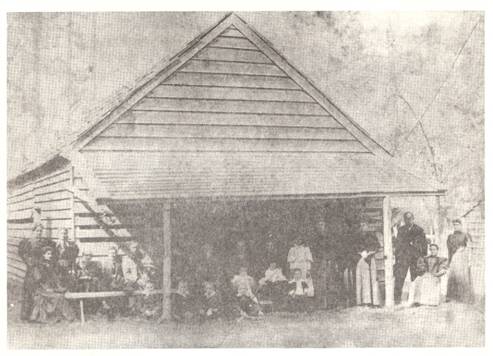
Note 10. The Camp Meeting picture, showing the David Wesley Evans' family in front of their "Tent" was likely taken in the fall of 1894, for Lee and Susanna Evans' twins look to be about one year old.
It seems safe to assume that Camp Meeting "tents" were so‑called in order to avoid conflict with the word "cabin", which could suggest typical dwellings provided in pre‑war slave�-quarters and hired‑hand rental property on plantations and farms of the period.
Camp Meeting Picture�Fall 1894
|
|
(Original Document, Page #14)
GLIMPSES OF MY UNCLES. MY AUNTS. AND MY MOTHER
BENJAMIN OSGOOD EVANS (BEN) 1848 ‑ 1921
Though I cannot recall ever seeing my Uncle Ben, I feel that I must give him a space in my story.
The only way I have of forming an image of Uncle Ben is to see him mirrored in the characteristics of his grandchildren, with whom I have been corresponding in recent months. With this as a guide, I shall always think of him as a patient, warm and loving person. And there are incidents related in the letters of his grandchildren which strongly support this image also.
Ruth Evans Barrett, in a nostalgic mood, recounted a horse and buggy ride she and her cousin, Dorothy Evans Hosterman, had with their grandfather one Sunday. It wasn't one of these brief rides they sometimes took with him, but a ride all the way from Bowman to Providence. And fond relatives were on the end of the journey too. Can't you just hear the chatter of these two little girls above the clop, clop of the horses hoofs and see the smile of satisfaction on the grandfather's face as they traveled the sandy road?
He must have been a doting grandfather. Thelma Prickett Ward is another grandchild, who loved to visit in her grandparents' home. She mentioned that Grandmother was sick a lot and it was left to Grandfather largely to make the preparations for her visit. What did he prepare that she liked? Nothing short of boiled peanuts and peanut brittle! If this doesn't make your mouth water, you've never eaten these goodies prepared by one of the David Evans family.
The Benjamin Evans family lived in the Pine Grove Community, Lone Star, South Carolina, until 1894, at which time they moved to Bowman. South Carolina. There Uncle Ben was a mail carrier. I wonder if he sometimes yearned to travel to some of the places stamped on letters and packages he delivered. It is singular that three of his daughters did spend a good portion of
|
|
(Original Document, Page #15)
their lives in places far distant from their childhood home.
Take Daisy, said to have been a beautiful blond. She and her first husband, John M. Berry, presumably lived in South Carolina. When she later married a Mr. Danzig or Danzick (only the pronunciation is re�called), it is said, they went to New Orleans to live. Any later information on Daisy's life is hazy.
Ethel was the last girl to leave home. Since her mother wasn't very well, she likely felt it her duty to stay at home as long as her mother lived. I know there were brief visits to Uncle Fred's home, for it was then that we learned to know her. A very pretty young lady she was too.
She must have had a motherly instinct, for when her sister Ruby died at a young age, leaving behind a dear little baby boy, Ethel took him to her parents' home and cared for him until his father's family came to get him. Still an infant, the child was taken north ‑ to New Jersey, it is thought.
After her mother died, in 1919, Ethel went to Battlecreek, Michigan, to train as a nurse. Later we find her in Los Angeles, where she lived alone for a number of years. At some time before 1942, she married a naval officer, Commander William H. Galbraith and we find them living then in Bremerton, Washington. They were also said to have lived in Lemon Grove, California and retired at San Diego, California.
Then there was Sadie Lucille. She left South Carolina for a purpose not unusual. Sadie married a physician, Dr. W. L. Mack, in 1918 and lived in Cordova, South Carolina, until 1947, when they moved to Walla Walla, Washington, to be near a daughter already living there.
|
|
(Original Document, Page #16)
JOHN FREDERICK EVANS (FRED) 1850 ‑ 1917
Uncle Fred married my father's first cousin, Lizzie Dantzler, daughter of Irvin and Lavinia Felder Dantzler. As I recall it, he was the only one in the family who was stout. The expression, fat and jolly, applied well to him. It was always a fun time to spend a Sunday afternoon in their home. Since they lived only a few miles down the State Road from us, we saw them more often than our other Evans relatives.
The house they lived in belonged to Aunt Lizzie's parents. It was quite old and not very commodious, but it housed some of the most hospitable people I've ever known. There was always room for one more ‑ or several for that matter ‑ at their bountiful table.
Aunt Lizzie's mother, living with them, was quite aged and bedridden when I knew her. She was lovingly cared for by her daughter and her granddaughter Vinnie Wimberly, a widow with four children also living there. One of the children, Mildred, near my age, died rather suddenly when she was about 11 years old. Naturally, it made a deep impression upon us children.
Evangeline recalls an apparatus Uncle Fred made for the fireplace to be used on ironing day. It was a frame made of tin, so constructed as to protect the irons from soot as they heated before the open fire. She isn't sure that it was his invention, but he sold some in the community and Papa bought one. It must have worn out before I was old enough to iron, for my ironing experience was like Mama's in her young days.
One of Uncle Fred's sons, Robbie, married and living in Cameron, delivered mail on our route in my growing up years.
Two of Uncle Fred's daughters, Nellie and Edith, were R.N.'s. They were very thoughtful of their father's needs as he became less active in his later years. After he had a stroke and was unable to walk, Edith gave him a cuckoo clock. He loved to see the thrill on the faces of children as the little bird
|
|
(Original Document, Page #17)
came out to announce the hour. And when the cuckoo stopped chirping, you could expect a chuckle from Uncle Fred.
Felder stayed in the home running the farm for his father in his declining years. A few years after the death of his parents he married and settled in Cameron, South Carolina.
MARY ANN CATHERINE EVANS (MANIE) 1851 ‑ 1914
Aunt Manie was the oldest girl in the family. She married her first cousin, Lewis Evans, son of Wade and Sarah Ann Evans. They lived in the Providence Community not far from her parents' home.
Providence was about ten miles down the State Road from our home, so, when Aunt Manie and Uncle Lewis visited us, they often spent the night. My sister Evangeline recently reminded me of the delicious hickory nut brittle Aunt Manie brought Mama on these occasions, for she knew Mama loved it. Loved it? Who didn't!!
Aunt Manie was a quiet, unassuming person, a fine example of Christian fortitude.
Two of her family were to become very close to our family. Eulalie (Cousin) came to live with us after Mama's sister Lula (our Auntie), who had been making her home with us, married. In fact, Evangeline says she came the day of Auntie's marriage to the Rev. D. D. Dantzler, a retired Methodist minister (d.1922), who was also her first cousin and a widower for the second time. We do not have the date of their marriage; but we think it was in the year 1904.
Mama's health was such that she needed someone to help her with us children ‑ there were three of us at that time. Then when Papa took work at the newly founded Cameron Bank, his hours were too long for him to give the proper time to the farm and so he asked Virgil to come and oversee the farm work. Both were a part of our family and fitted in nicely.
|
|
(Original Document, Page #18)
Cousin was like a second mother to us. When Mama wasn't around, we knew to take orders from her. She had the privilege of spanking us, but I don't recall her ever spanking even mischievous me.
Aunt Manie died in 1914. Some months before this, Cousin went home to help nurse her and did not return. We children, though amply able then to care for ourselves, missed her greatly. Virgil left about the same time to farm for himself several miles from Orangeburg. His leaving left a void felt by all of us too.
From time to time the others in the family visited us. There were Fannie and Jim Bair who occasionally brought their four well‑behaved children to spend the day. Raymond recently mentioned in a letter to me how much fun he and my brother James had at our house and theirs. Pretty little Athleen was my sister Elizabeth's age, so the day was never long enough when they came. And I especially remember the excitement when Lawton brought his bride for dinner one Sunday.
Carlisle was with us for several weeks when he was recuperating from a badly mangled arm. It was more convenient to be at our home than his parents' for he was under the care of our Dr. A. P. Traywick.
Lola and Maude visited us for a week or so at the time. I remember Lola for her hearty laugh and Maude for her talent as a seamstress. One summer, when Auntie invited me for a visit with them in Orangeburg, Maude was visiting us at the time. Without a pattern, she cut out and helped Mama make me a dress any little girl would have been proud of. It always seemed a shame that, after Maude married, she never had a little girl to sew for.
|
|
(Original Document, Page #19)
HARRIET MARGARET EVANS (HATTIE) 1853 ‑ 1930
When we heard that Aunt Hattie was planning to visit us, we children all raised a joyous cry. As I've already said, she entertained us with stories, songs and peep boxes.
I recall visiting her one summer after her husband Emmanuel Bull, whom she married late in life, had died. No woman in that day out in the country, as she was, dared to live alone, and so Aunt Hattie, true to form, had asked Mr. Bull's daughter and her family to move in with her. Again she had children crawling over her lap, listening to her stories. In a way, this was good for her and surely good for the children. Still comparing her to a 57 year old woman facing widowhood today, hers was, according to present standards, a rather hum‑drum life.
It seems a shame that during these years when she had no special ties, she couldn't have done some traveling, but I doubt that she ever got father from home that Brevard, North Carolina, where she went with our family on a vacation one summer. Her life was lived completely for others in the community in which she was born. And likely it was lived as she wanted it. After all, few women of her day could have inspired this brief eulogy in her obituary: "She was one of the most prominent citizens of the Providence Section." A strong woman, this Harriet Evans!
SUSAN FRANCES EVANS (TUDIE) 1857 ‑ 1922
Aunt Tudie's husband, Francis Spain Williams, was the postmaster at Eutawville, South Carolina, when I knew them. To visit them as a child I had to travel by train. Hattie Mae, the youngest in the family was near my age and, for that reason I was the one who was invited for week‑long visits in their home. They lived in the little town of Eutawville, but still had chickens and other fowl. I was intro�duced to guinea at Aunt Tudie's table, and, as she prepared it, it was delicious.
|
|
(Original Document, Page #20)
There was an older sister Bessie, who was an R.N. and five older brothers. Clifford, three years older than Hattie Mae, was asked by his mother to accompany Hattie Mae and me to some places where we wanted to go. This he graciously consented to do. I do not remember any of the other brothers except Duncan.
A handsome young man, Duncan worked in the Bank of Cameron with my father for several years. From there he went to Lebanon, Pennsylvania, where he took a position with a Mr. Millard, who owned a quarry and a farm. Eventually, Duncan was put in charge of Mr. Millard's business.
There was a daughter in the Millard family named Laura. Duncan and Laura became attracted to each other and the ensuing courtship resulted in a proposal of marriage. Like any sensible girl, she expressed the desire of meeting his parents before giving him a definite answer. Needless to say a cordial invitation was extended.
Entertaining a young lady from a different part of the country posed no problem for Aunt Tudie, for she was endowed with a charm and composure possessed by few. Obviously Laura was pleased with what she found in this hospitable Southern home, for she went back to Lebanon to make plans for a beautiful wedding.
For several weeks before I (Annie Belle) was married Mama hadn't been very well. Though no reception was planned, I did have a church wedding and there were guests in our home. Aunt Tudie came to help out so that our guests could be served Evans‑style meals. The wedding was October 19, 1922. Two months later, December 18, 1922, Aunt Tudie knelt by her bedside to pray and there, on her knees, she quietly slipped into eternity. A beautiful ending for a beautiful life!
|
|
(Original Document, Page #21)
TALULA ELIZA EVANS (LULA, AUNTIE) 1860 ‑ 1929
Of all Mama's sisters, Auntie was closest to us. It is thought that the impressionable years are from birth through four years of age. Auntie was in our home during our early years to love us and to receive our love. My mother loved her children as deeply as any mother ever loved, but she was not as demonstrative with her affection as was Auntie. Perhaps it was because she had no children of her own that Auntie seemed to have an insatiable thirst for caressing children.
And so it was that, after she married the lovable Daniel Dantzler and had a home of her own, she saw to it that a child from our family or Bess Wroton spent a week or more with them each summer. Uncle Dan seemed just as pleased to have us as she and we were soon loving him as much as any of our blood kin.
When the new baby Elizabeth (Betsy) entered our family, it was decided that it would be a good thing if James and I were "deported" for a few weeks. All they had to do was to give Evangeline a book to read and she would be quiet. Auntie felt she was the logical one to take us noisy ones in. At least she knew us from head to toe, or thought she did. But she likely didn't take into consideration their smaller house and lot compared to our roomy house and a large sandy yard available if our energies should explode.
Sure enough one cold January morn James and I were on the front porch "whooping it up." Out comes gentle little Auntie almost in tears, "Children, don't you know you are in the city?" That was the day we learned that life in the city was different from life in the country.
The day finally came for us to return home. Everything was fine for a while. Then I got the measles, James got the measles, Evangeline got the measles and baby Elizabeth, six weeks old, got the measles. As if that wasn't enough, we gave the baby whooping cough when she was six months old.
|
|
(Original Document, Page #22)
Auntie once remarked to me, "All my sisters were pretty. I was the ugly duckling in the crowd." It's true she could never have won a beauty contest; but she had a heart of gold and her sweet inner spirit so shone through her face that no one ever thought of any lack of physical beauty.
I have often said that I have never personally known anyone who lived the Christian life as consistently as Auntie did. She seemed always to keep before her the injunction of Jesus, "Whosoever will come after me, let him deny himself and take up his cross and follow me."
To know someone in need was in her thinking to do something about it. Whenever money was a factor, she managed somehow to contribute to the cause. Apparently she became more generous after Uncle Dan's death, even though she had less to run on than before. As a retired minister, he was on a church pension, which in addition to the rental from a good‑sized farm he inherited, furnished them with a fair income. In making his will, at Auntie's request, he left most of his property to his children. He took for granted that she would also get a pension. This was not the case and she had to be very careful with funds over the seven years of her widowhood.
Long before these critical years she had made a pledge to herself to leave enough money for the building of a chapel in Korea, and she was determined her plans would not be thwarted. She actually deprived herself of food she should have had for health's sake to make sure her chapel funds would not be deleted. Such was the devotion of our dear little Auntie.
ELIZABETH BEAUREGARD* EVANS (BETTY) 1861 ‑ 1899
From all I've ever heard about Aunt Betty, I know I would have loved her, but she died before I was a year old. One of my treasured possessions is a little pink baby sacque she crocheted for me. As I wrote Jimmie she must have set my love for pink, for it is my favorite color. I was told that, at a camp meeting, to which my parents took me at a tender age ‑ if I ever went through such an age ‑ I pranced around one
*No Kin, but named after Gen. Peter Gustavus Toutant Beauregard 1818‑1893, Defender of the South, beloved and admired by David Wesley Evans, father of Elizabeth Evans.
|
|
(Original Document, Page #23)
day, demanding they put a pink dress on me. I never thought to ask who won out, but, judging from later happenings, it wasn't little Annie Belle.
After Aunt Betty died on September 13, 1899, Mama thought of her dear sister's family as a kind of extension of her own family. Lula Bess was only two at the time of her mother's death. While the older children could make it very well with their father, Mama and Aunt Lure (Auntie), who was living with us then, felt the little baby girl should have some genuine motherly care. So for several years she lived in our home. Then Auntie married and Lula Bess went back with her family. But she often visited us weeks at a time during the summer months. A precocious child, she learned to read fluently at an early age and loved the funnies. I couldn't understand how she could enjoy looking at such ugly creatures - I much preferred romping on the outside.
In the summer of 1901 tragedy struck the Wroton home in Denmark, South Carolina. Victor, the eldest, came down with typhoid fever. Auntie went to help and Genevieve was sent to our home to join Lula Bess who was already there. After some days, Genevieve also got sick. Mama, though pregnant, nursed her through that critical illness to health. Victor was not so fortunate. He died one month before his nineteenth birthday.
It was a happier stay that Genevieve and Bess had with us some years later. This time they spent the entire summer. Genevieve had become a beautiful young lady and two eligible young men took turns calling on her.
Hattie wasn't free to visit us very often, but it was a special treat to have her. She became a good business woman like her capable Aunt Harriet, for whom she was named, but it was her affectionate manner that lingers in my memory. I recall too some brief visits from Harry and it was a big event when Jimmie and Daisy stopped by for an overnight visit soon after they were married. We were always proud of Jimmie and fell in love with his sweet bride.
|
|
(Original Document, Page #24)
DAVID WESLEY LEE EVANS (BUDDY) 1864 - 1924
Uncle Buddy was next to the youngest in the family, my mother being the youngest. Jimmie Wroton has commented on his hunting and fishing experiences with Uncle Buddy. I can't vouch for his expertise as a hunter but I do know that he was a very successful fisherman, for, after cars came into use, some of his fish found their way to our home. And I'll never forget how good the fish were at Aunt Sue's table when I visited them--fish, fresh from the pond, hot from the frying pan.
Not only was Uncle Buddy a successful fisherman, but he was also a resourceful one. Fishermen, can you beat this? According to a fond nephew, he sometimes rode a cow to the fish pond to have fresh cream for his coffee. Poke fun if you wish. I think he was smart. The cow served two purposes, the thermos bottle you carry serves only one.
Mama used to say that, when they were children, she was Buddy's shadow, often much to his dismay. He must have let her fish with him sometimes, for she too was good with the hook and line. Even in her later years during her vacation visits with us in the summers at Wilmington, North Carolina, her greatest pleasure was fishing from the pier for a few hours at the time with my husband.
The same resourcefulness, that Uncle Buddy displayed in his fishing, was also seen in his farming. Fairly early in his married life, he began diversifying on the farm by planting a large pecan grove. At that time, there were only a few other South Carolina farmers in the pecan business. He started with the hard-shelled nuts, then, when the paper shell nuts became more popular, he set out to modernize his grove and grafted paper shells on many of the trees himself.
His daughter, Louise Evans McCrorey recalls the harvesting of the nuts. "Blacks on the place climbed up in the trees and, with long poles, knocked the nuts down. We children were always under the trees picking
|
|
(Original Document, Page #25)
them up and being 'konked' on the head by the falling nuts."
The thumps on the head evidently didn't do any harm to Louise for she served as principal in schools near her home over a period of thirty years.
Having such a background in farming, it is not surprising that son Frank, a Wofford graduate, developed into an outstanding farmer. In 1959 Frank's family was named South Carolina Master Farmer Family.
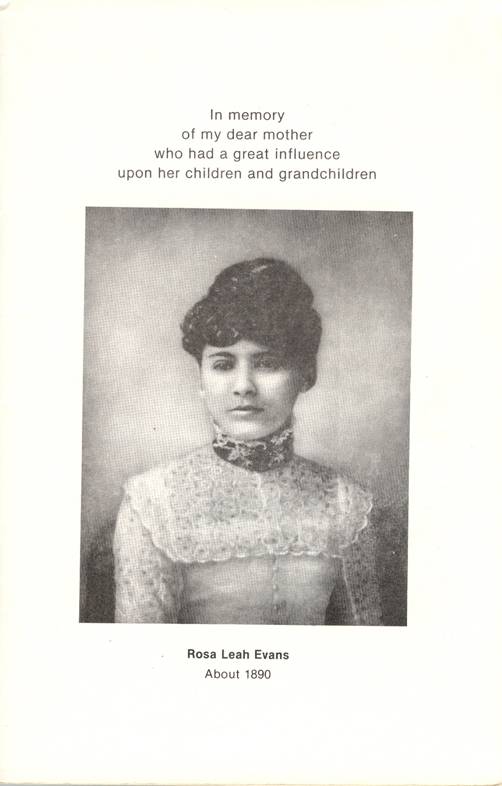
ROSA LEAH EVANS 1866 ‑ 1954
Since a thread of Rosa Evans' life runs throughout my story, I had not planned to give her additional space here. That is, until I began to wonder if I might have given the impression that she enjoyed poor health. Then it was that I decided to dispel any such idea.
Rosa Evans my mother was a very active person. It was she who kept the wheels turning smoothly in a busy farm home while my father was devoting a full day at the Cameron Bank. Unless she had a bad night, she was up early in the morning busying herself with a big breakfast.
It was she, who planted the seed in the garden after the soil was prepared, who cared for the chickens, who, in the sugar cane season, tested each vat of cane syrup for its consistency, who, on hog butchering days, carefully examined and helped prepare the parts of the haslets that went into the stuffed liver puddings and, who personally directed the curing of her succulent hams.
She managed to find various ways to make a little money of her own. One project was her boiled peanut business. The vines were gathered for her before most of the peanuts became hard. As they were picked from the vines, those few which were hard were put aside for drying and only those which would cook
|
|
(Original Document, Page #26)
soft were used. They were boiled in large wash pots on Friday. On Saturday morning they were sacked in small bags and sold for a nickel in Cameron. My bro�ther James was the little salesman, who received a small commission.
Always there was a goal in sight, the biggest being a piano in order that her girls might take ad�vantage of music lessons. Though Betsy was the only one of us who became an accomplished pianist, the pleasure her music brought to others fully repaid Mama for her efforts.
I must not be tempted to say more about Rosa Evans except that she lived over a span of nearly 88 years ‑ longer than any of her sisters or brothers and a little more than two years short of the 90 year mark predicted for her by her affectionate nephew, Jimmie Wroton.
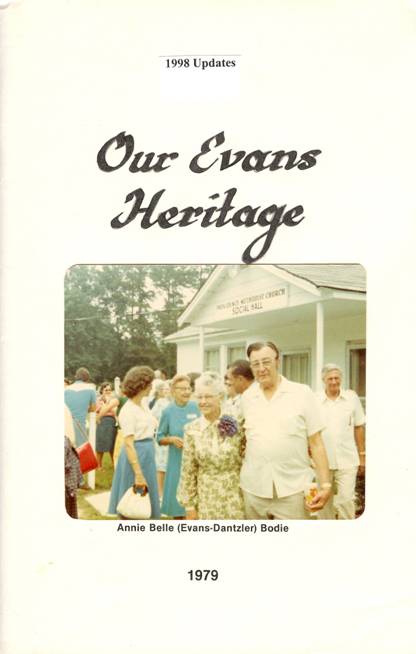
�The Old Church� photograph hanging in the narthex of present building Providence United Methodist Church Home church of �Our Evans Heritage� families at Providence, SC 5-24-81
|
|
|


|
(Original Document, Page #27)
THE GENEALOGY
In order that the genealogy may be better understood, I offer a few words of explanation. The section of South Carolina in which our early ancestors lived was known as St.Matthew Parish, Orangeburg District. In 1868 the Constitution changed the Districts into smaller area called Counties. From this date on, our Evanses lived in Orangeburg County.
The name Providence Community has no relation to government, as did the Parishes; rather, it emerged because of the influence of Providence Methodist Church upon the surrounding community. While the St.Matthew Parish covered a much larger territory than the Providence Community does now, either term can apply to the land holdings of our ancestors.
Wherever the Providence Community is referred to in the genealogy, it is always the Providence Community of what is now Orangeburg County.
Key: I, II, III, IV = Generations c = child g = grandchild gg = great‑grandchild ggg = great‑great‑grandchild
m. = married; b. = born; d. = died
|
|||
|
(Original Document, Page #28)
I. ROWLAND EVANS
ROWLAND EVANS, b. in Wales before the year 1749, He was killed a few days after the Battle of Eutaw Springs, fought 8 Sep 1781. Rowland lived consecutively in Boston, Charles Town, and the St. Matthew Parish, Orangeburgh District. He married Elizabeth Day. Through the efforts of the Eutaw Chapter of the DAR, his grave has been marked by the US Government. (see DAR Patriot List‑1967, pp.224‑225).
II. Children of Rowland and Elizabeth Day Evans
C(l) ROWLAND EVANS (died young, no dates found)
C(2) JOHN EVANS, b. likely in Charles Town, 1771 or 1772, depending on his birth month, d. 11 Oct 1859 (Dates from Kelley, Southern Christian Advocate of 19 Jan 1860 ‑ Moorer records give his birth as 1772), married lst. Martha Zimmerman (no dates ‑ from Mrs. Mary East Keller). John married 2nd. Margaret Moorer, daughter of Jacob Moorer, b. about 1746. She was b. in 1777 (Mary East Keller), d. Ju1 1823 (Harriet C. Bull's story).He married 3rd.on 1 Dec 1825,a widow, Elizabeth Holman Zimmerman, daughter of Conrad Holman (Marriage Settlement Book 9, SC Archives page 173 ). She was buried in old Zimmerman Cemetery. Others likely unmarked in the old cemetery.
C(3) MARY (Polly) EVANS, b.1774, d.4 Feb 1862 in St. Matthew Parish, married Jacob Moorer, b. 15 Sep 1770, d. 17 Jul 1840. Jacob was a brother of Margaret Moorer, who married John Evans (Moorer Records). Polly and John were sister and brother.
C(4) WILLIAM EVANS, b. 25 Dec 1776. St. Matthew Parish, d. 20 Sep 1859 at his residence in St. James Goose Creek Parish, SC. (Obit. Southern Christian Advocate), married unknown. A known descendant is Wm. Barnwell �Bud� GROSS, Jr, b. 15 Jun 1927 and living in Summerton, SC.
II. JOHN EVANS
III. Children of John and Martha Zimmerman Evans
C(1) ROWLAND EVANS, b. 4 Feb 1797 (Date given the Calhoun County Museum by Sadie Bates Cannon who took it from the Bates Bible), d. unknown.
|
|||
|
(Original Document, Page #29)
C(2) RICHARD (Dick) EVANS, b. St. Matthew Parish 1805 (1850 Census), d. after 1879, married Mildred GRIFFITH, daughter of Abraham and Ann Parsons Griffith (Mrs. Mary East Keller) Buried in Old Cemetery. He had a grandson living in Cameron, SC, circa 1900.
III. Children of John and Margaret Moorer Evans
C( l) LEAH EVANS, b. in 1805, d.11 Jun 1901, St. Matthew Parish (Times and Democrat, June 19,1901)(Not in Bates Bible). She is buried in the Old Cemetery.
C(2) WADE EVANS, b. 4 Oct. 1807, d. 30 Sep 1897, St. Matthew Parish, married 1st. 29 Nov. 1827, Sarah Ann HALL. She was b. 11 Sep. 1810, d. 21 May 1865.Wade married 2nd Elizabeth D_, b. 29 Aug 1835, d. 3 Nov 1878. He married 3rd. Mary E_, b. 29 Aug 1832, d. 8 Dec 1918. All are buried in the old family cemetery. A known descendant of Wade and Sarah Ann Hall Evans is Robert Evans DOUGAN, living (1996) in Warner Robins, GA.
C(3) ELIZA EVANS, b. 5 Dec 1809, d. 29 Jun 1872 in St. Matthew Parish, unmarried. Buried in the old family cemetery.
C(4) LEWIS EVANS. b..24 Jul 1814 (Bates Bible) in St. Matthew Parish, d. 22 Jan 1897 in Pittsburg, Texas, where he made his home (Times & Democrat, 10 Feb 1897).
C(5) ELIZABETH EVANS, b. 19 May 1817, d. 20 Apr 1890 (9 AM) in St. Matthew Parish, married 8 Dec 1842, Dr. Rezin Westerly BATES. He was b. 17 Feb 1819, d. 21 Apr 1892 (Given me from the Bates Bible).
C(6) MARY ANN EVANS, b. 6 Sep 1819 (Bates Bible) in St. Matthew Parish, d. 27 May 1899 in Anderson, SC. She was the second wife of Col. John Cubbage EDWARDS, CSA (T&D 31 May 1899) and was 31 in the 1850 census. He was b. 3 Nov 1823, d. 3 Dec 1886 (Gravestone).
C(7) DAVID WESLEY EVANS, b. 13 Jul 1823, d. 28 Feb 1900 in St. Matthew Parish, married 8 Apr 1847. Frances Eran DANTZLER, b. 27 Apr 1820, d. 2 Dec 1892, daughter of Frederick (not in the Bates Bible) and Mary Ann Catherine Moorcr Dantzler.
III. DAVID WESLEY EVANS
DAVID WESLEY EVANS. son of John and Margaret Moorer Evans, married Frances Eran Dantzler. They lived in the Providence Community and are buried in the Old Family Cemetery.
|
|||
|
(Original Document, Page #30)
IV. Children of David Wesley and Frances Eran Evans
C(1)BENJAMIN OSGOOD EVANS, b. 12 Mar I848, d. 22 Dec 1921.
C(2) JOHN FREDERICK EVANS, b. 7 Jan 1850, d. 16 May 1917.
C(3)MARY ANN CATHERINE EVANS, b. 27 Nov 1851, d. 9 Jun 1914
C(4)HARRIET MARGARET EVANS, b. 17 Jun 1853, d. 22 Aug 1930.
C(5) OLIN DANTZLER EVANS, b. 26 Jul 1855, d. l Jul 1856.
C(6) SUSAN FRANCES EVANS, b. 21 May 1857, d. 18 Dec 1922.
C(7) TALULA ELIZA EVANS, b. 4 Jan 1860, d. 7 May 1929.
C(8) ELIZABETH BEAUREGARD EVANS, b. 29 Jul 1861, d. 13 Sep 1899.
C(9)DAVID WESLEY LEE EVANS, b. 10 Apr 1864, d. 10 Sep 1924
C(10) ROSA LEAH EVANS. b. 8 Aug 1866, d. 23 Apr 1954.
1996 Reunion NOTE: Mrs.Stella Branton Way and daughter Carol Evans Way were at Reunion. They had a looseleaf book of family data to share. Carol said:
Aurie Olive EVANS married Leslie Augustus Way of St. George. 3 children: Leslie Albertus Way Reba Dell Way, married Johnnie Talton Robert Evans Way
BENJAMIN OSGOOD EVANS
BENJAMIN OSGOOD (BEN) EVANS, son of David Wesley and Frances Eran Dantzler Evans, was born 12 March 1848 in the Providence Community, died 22 December 1921, married 1871, Susan STREET from St. George, SC. She was b. 22 Apr 1853, d.15 Sep 1919. They lived in the Pine Grove Community near Lone Star, SC until 1894 when they moved to Bowman, SC. They are buried in the Bowman Cemetery.
THEIR DESCENDANTS
MARY LOUISE EVANS (Mamie), dau. of Benjamin Osgood and Susan Street Evans, b. 5 Nov 1873 in the Pine Grove Community, Lone Star, SC, d. 5 Jul 1942, married John Baptist Prickett. He was b. in 1872 and died 15 Mar 1933. He served in the South Carolina General Assembly several terms. They lived in St. Matthews, SC and are buried there in West End Cemetery, St. Matthews, SC.
|
|||
|
(Original Document, Page #31)
C(1) HAZEL PRICKETT, b. 27 Jul 1898 in Pine Grove Community, Lone Star, SC, d. 19 Jan. 1978, married 19 Jan 1921 in St Matthews (SC) Baptist Church, Jesse Thomas ANDERSON, b. 26 Oct 1890 in Timmonsville, SC. He holds an M.A. degree from USC and honorary LLD from Furman. They lived in Florence, SC where he was for 17 years Supt of Education for Florence County. Moving to Columbia in 1947 he served for 20 years as State Superintendent of Education. Hazel is buried in Columbia.
g(1)MARY LOUISE ANDERSON, b. 5 Mar 1922 in St. Matthews, SC, married 5 Oct 1942 in Florence, SC, Earle M. Rice. She d. 18 Jan 1967 and is buried in Anderson, SC where they lived and where Earle had a law practice.
gg(1) MARY EARLE RICE, b. 26 Sep 1943, Florence, SC, married in the fall of 1969 in Anderson, SC, Dr. Ralph HAYNES. He was b. 23 Dec 1943 in Germany. Home Atlanta, GA.
ggg(l) LESLEY HAYNES, b.5 May 1972 in Atlanta.
ggg(2) RUSSELL HAYNES, b.17 Apr 1974, Atlanta.
ggg(3) MATTHEW HAYNES, b.23 Jun 1978, Atlanta.
gg(2) JESSE ANDERSON RICE. b.4 Dec 1946, Florence, SC, married lst. in spring of 1969 Anne Clark, from Anderson, SC. They were divorced in 1975. `
ggg(1) JESSE ANDERSON RICE, Jr., b. 23 Feb 1970, Columbia, SC.
gg(2) JESSE ANDERSON RICE, married 2nd 20 Dec 1976 in Anderson, SC, Nancy GOODYEAR, b.1948 in Anderson. Home Atlanta, GA.
gg(3) LOUISA RICE, b. 4 Feb 1950 in Anderson, entered University of SC Law School in 1979 in order to later practice law in Anderson with her father.
g(2) FRANCES LETITIA ANDERSON, b. 8 Aug 1925 in
|
|||
|
(Original Document, Page #32)
Timmonsville, SC, d. 14 Aug 1975, married 27 Aug 1947 in Columbia, SC Frank D. FULTON, b. 15 Dec 1924 in Florence, SC. She is buried in Martinsville, VA where they made their home.
gg(1) FRANK DUDLEY FULTON, b. 17 Nov 1948 in Florence, SC, married Sep 1974 in Martinsville, VA, Martha Jane BARNES b. 3 Sep 1948 in Martinsville.
ggg(l) JASON FULTON. b. 5 Oct 1975, Newport News, VA.
gg(2) ROBERT BENJAMIN FULTON, b.25 Apr 1951, Florence.
gg(3) MARY LOUISE ANDERSON FULTON, b. 9 Jun 1964, in Martinsville, VA.
g(3)HAZELANN ANDERSON, b. 7 Dec 1930 in Florence, SC, m. 1st. 30 Jan 1951 in Columbia,SC (separated 1974) Edmund Hayward MONTEITH b. 6 Jun 1930 in Columbia.
gg(1) HAZEL PRICKETT MONTEITH, b. 1 Oct 1956 in Columbia.
gg(2) FRANCES ANDERSON MONTEITH, b. 10 May 1958, Columbia.
gg(3) EDMUND HAYWARD MONTEITH, Jr., b. 18 Feb 1961, Columbia.
g(3) HAZELANN ANDERSON (MONTEITH), m. 2nd. summer of 1977, F.D.FULTON. Their home Martinsville, VA.
C(2)BESSIE ALLENE PRICKETT, b. 26 Feb 1902, St. Matthews, SC, m. 19 Oct 1926 in St. Matthews Baptist Church, William Redmond MERCER. He was b. 28 Aug 1901. Home Charlotte, NC. There are no children.
C(3) THELMA CECILE PRICKETT, b. 1 Oct 1906 in St. Matthews, m. 20 May 1929 at her parents' home there, Bernard O. WARD, b. 22 Nov 1903 in Conway, SC. Home Bladenboro, NC.
g(1) MARY CECILE WARD, b. 3 Jan 1931, m. 6 Jun 1950 in Bladenboro, Robert Allison WHITE. He was b. 5 Mar 1927 in Lumberton, NC. Home Allendale, NJ.
|
|||
|
(Original Document, Page #33)
gg(1) ROBERT ALLISON WHITE, Jr., b. 26 Dec 1951, Lumberton,NC.
gg(2) BERNARD WARD WHITE, b. 12 Apr 1955, Staunton,VA.
gg(3) ELIZABETH CECILE WHITE, b. 31 Aug 1959 in Staunton, VA.
gg(4) REBECCA SUSAN WHITE, b. 17 Nov 1960, Richmond, VA.
g(2) JOHN PRICKETT WARD, a twin, b.25 Dec 1942 in Thompson Memorial Hospital, Lumberton, NC. He m. l 1 Feb 1967, in Southern Pines, NC, Reba Lorraine BEITH. She was b.4 Jun 1945 in New Jersey. He was a USAF Major(1979).
gg(1) REBECCA LORRAINE WARD, b. 10 Jun 1969 in Wichita, Kansas.
gg(2) PATRICIA MICHELLE WARD, b. 31 Jan 1972, in Wichita.
g(2) JAMES BERNARD WARD, a twin, b.25 Dec 1942 in Thompson Memorial Hospital, Lumberton, m. 9 Jul 1967 in Edenton, NC, Emily Faye LONG. She was b. 25 Aug 1946 in Edenton. He was a Major in the US Air Force.
gg(1)MICHAEL JAMES WARD, b. 11 Apr 1971, Wichita, KS.
gg(2)STEVEN BERNARD WARD, b. 29 Aug 1973 in Wichita.
g(4) BESSIE ALEINE WARD, b.23 Feb 1945 at Thompson Memorial Hospital, Lumberton, m. 30 Jun 1968, in Bladenboro, NC, William Richard DAVIS. He was b.28 Jul 1945 in Bladen County, NC. Home Rural HaII, NC.
gg(1) KAREN CECILE DAVIS, b. 8 Mar 1971, Raleigh, NC.
gg(2) WILLAM RICHARD DAVIS, Jr b.23 Oct 1973, Raleigh, NC.
|
|||
|
(Original Document, Page #34)
DAISY E. EVANS, daughter Benjamin Osgood and Susan Street Evans, b. 27 Aug 1875 in the Pine Grove Community, Lone Star, SC. m. lst. John M. BERRY. They evidently lived in SC.
C(1) LAWTIS (LAUTIS) BERRY (Only her name is recalled)
DAISY E. EVANS, m.2nd a Mr. Danzig (or Danzick (only the pronunciation is recalled)). They went to New Orleans to live. Further definite information on her and her child has not been forthcoming.
OLIN PLATTE EVANS, son of Benjamin Osgood and Susan S. Evans, b.17 Apr 1880 in the Pine Grove Community, Lone: Star, SC, d.16 Dee 1957, m.15 Jul 1908 Myrtle BEACHAM in Prosperity, SC who d. 4 Apr 1957. They lived in Bowman until about 1923, then mowed to Spartanburg, SC. They are buried in the Bowmsn, SC Cemetery.
C(1) DOROTHY EVANS, b.25 Jan 1910 in Bowman, m. 4 April 1936, James Lewis HOSTERMAN in Spartanburg. He was b.19 Feb 1909 in Spring Mills, PA, d. 14 Jan 1984. Dorothy continues to live in Decatur, GA.
g(1) DORTHY SUSAN HOSTERMAN, b.12 Dec 1953 in Atlanta, GA, m.15 Aug 1981 in Atlanta, N. Frederick JAQUES. He was b.10 Apr 1953 in Orangeburg. She is a Dentist in Holly Hill. Home Bowman, SC.
gg(l) BRYAN LEWIS JAQUES, b.9 Dec 1984 in Charleston.
gg(2) ANDREW PATRICK JAQUES, b.16 Sep 1987 Charleston.
C(2) AYLETTE PLATTE EVANS, b.10 Aug 1915 in Bowman, SC d. 6/7 Jul 1994, m.1 l Oct 1954 in Dayton, OH . Hazel CORRELL. She was born 11 Apr 1928 in Chillicothe, OH d. May 1979 in Dayton, Ohio. They lived in Centerville, Ohio.
g(1) APRIL CAMILLE EVANS b.27 Mar 1957 in Dayton, OH m.5 Aug 1978 in Nashville, TN. Brian John Brooks. He was b.9 Jul 1955 in Oshkosh, W1. Divorced 1979. She m.2nd Jul 1988. Divorced.
C(3) HORACE LLOYD EVANS b. l Oct 1917 in Bowman, d. 5 Oct 1983, m.25 May 1957 in Dayton, Lucille ULWELLING. She was b. 7 Sep 1916 in Rose Creek, MN. Home Dayton, OH.
JESSE CLIFTON EVANS son of Benjamin Osgood and Susan Street Evans, b.4 Aug 1883 in Pine Grove Community at Lone Star, d.12 Sep 1967,
|
|||
|
(Original Document, Page #35)
m. 9 Nov 1906 Azalie Elizabeth Smith. She was b.25 Sep 1883 in Bowman, d.20 Aug 1958. They moved from Bowman to Orangeburg in the summer of 1923.They are buried in the Bowman Cemetery.
C(I) JESSE CLIFTON EVANS, Jr., b.18 Jan 1909 in Bowman, d. 27 Nov 1966. Single, he is buried in Bowman Cemetery.
C(2) RUTH VIRGINIA EVANS b.31 Dec 1910 in Bowman, m.14 Jun 1939 in Orangeburg, Samuel James Barrett. He was b. 22 Jul 1907 in Columbia, SC, d. 18 Nov 1985. Home Columbia.
g(1) SAMUEL JAMES BARRETT, Jr. b. 11 Oct 1946, Columbia, SC m. 11 Aug 1984, Katherine Lynne BJERKER in Sumter, SC where be is an educator.
g(2) MEREDITH ELIZABETH BARRETT b. 30 Nov 1950, in Co1umbia, SC m. 18 Dec 1976 in Columbia Dr. Barnett Wayne BERRY. He was b.7 Feb 1956 in Columbia. Home McLean, VA.
gg(1) JOSEPH BARRETT BERRY b.7 Jun 1982, Carrboro, NC.
gg(2) EVAN REBECCA BERRY b.7 Sep 1987 at McLean,VA.
C(3) MARY BEVERLY EVANS, b.19 Apr 1923 in Bowman, m. 28 May 1949, John Thomas Edge. He was b. 31 Aug 1926, Crest View, FL. Home (Clinton) Gray, GA.
g(1) JOHN THOMAS EDGE, Jr, b.22 Dec 1962, Macon, GA.
RUBY B.EVANS, dau/of Benjamin Osgood and Susan Street Evans, b..16 Oct 1889 in the Pine Grove Community at Lone Star, SC, d. 1916. She lived for awhile with her sister Mrs‑ Mary Louise Prickett in St Matthews, SC where she m. Ned Hearne. She is buried in the Pickett plot in West End Cemetery at St.Matthews.
C(1) EDWARD EVANS HEARNE, b. unknown. After being cared for by his Aunt Ethel in Bowman for some time when his mother died, he was taken as an infant to New Jersey by his father.it is thought. The family lost trace of him.
|
|||
|
(Original Document, Page #36)
ETHEL MAY EVANS, dau./of Benjamin Osgood and Susan Street Evans, b. 31 March l891, Pine Grove Community, Lone Star, SC. She trained as a nurse in Battle Creek, Ml and lived in Los Angeles for a number of years. At sometime before 1942 she m. Wm H. GALBRAITH, Cdr. USN. They lived is Bremerton, WA, Lemon Grove, CA, and retired at San Diego, CA. Her death date is unknown.
SADIE LUCILE EVANS, dau./of Benjamin Osgood and Susan Street Evans, b.27 Sep 1894 in the Pine Grove Community, d. summer of 1974. She m. 1918, Washington Lee MACK, MD. He was b. 4 Dec 1869, Cordova, SC, d. Sep. 1949. They moved west in 1947. Both died and are buried in Walla Wal1a,WA.
C(1) WASH1NGTON LEE MACK, Jr., b.8 Jun 1919 in Cordova, SC.A musician/professor, he m. 1st.1938(?) Dorothy MADDOX. Divorced, m.2nd 11 Mar 1951 Monta MONTGOMERY. She died 6 Sep 1952. He m.3rd., Bette _____. Divorced, m. 4th 22 Sep 1971 Jeame DECKER.
g(1) LAURA LEE MACK, b. l6 Apr 1956 in Vancouver, WA, m. 21 Jun 1975 Bent SMITHLINE.
g(2) CYNTHIA MACK, b.12 Apr 1959 in Vancouver.
C(1) WASH1NGTON LEE MACK, Jr., married 4th, Jean Becker, September 22, 1971.
C(2)VIRGINIA EVANS MACK, b. 1 Apr 1923, Cordova, SC, m.17 Jun 1944 in Cordova, Robert Otis KENYON.. He was b.17 Ju1 1918 in Condon, OR. Home Walla WaIIa, WA.
g(1) ROBERT STEPHEN KENYON, b.28 Dec 1948, Walla Walla. He changed his name (after 1970) to STEPHEN OTIS KENYON, m. 24 Mar 1974 in Walla Walla, Deborah DUNBAR (who kept her maiden name). She was b.17 Feb 1949. Home (1980) Seattle, WA.
g(2) CAROLYN KENYON, b.8 Sep 1950 in Walla Walla. She kept her maiden name when she m.19 Apr 1974 in Seattle, Steve SHLAFER. Home (1980) Gothenburg, Sweden.
|
|||
|
(Original Document, Page #37)
g(3) CHRISTI MARIAN KENYON, b.31 Aug 1957 in Walla Walla, WA.
JOHN FREDERICK EVANS
JOHN FREDERICK EVANS (FRED), son of David Wesley and Frances Eran Dantzler Evans, b.7 Jan 1850 in the Providence Community, d.16 May 1917, m. 5 Jan 1871, Elizabeth (Lizzie) DANTZLER daughter of Irvin and Lavinia Dantzler. She was b.16 Aug 1852, d. 30 Jun 1915. They lived 7 miles south of Cameron, SC and are buried in Jericho Methodist Church Cemetery.
THEIR DESCENDANTS
CHARLES WESLEY EVANS (CHARLIE), son of John Frederick and Elizabeth Dantzler Evans, b. in 1871, 7 miles south of Cameron, d. in 1933, m. Marie (Mittie) FAIREY, b. in 1875, d. 1960. He was an undertaker in Camden, SC. Both are buried in Quaker Cemetery, Camden.
C(l) SAM EVANS (deceased, no dates available) when last heard from was living with his 4th wife in Dalton, GA.
FRANCES LAVINIA EVANS (VINNIE), b.9 Feb 1874, 7 mi. S. of Cameron, SC, d. 17 Nov 1958, m.1st. John O.S.WIMBERLY from St. George, SC on 10 Jan 1894. He was b. 27 Jan 1868, d. 4 Jan 1902. They are buried in Cameron Cemetery.
C(1) HARRY DANTZLER WIMBERLY, Sr, b. 10 Feb 1895, 7 miles S. of Cameron, d. 17 Mar 1965, m.26 Aug 1917, Truman Miles, b. 14 Aug 1894 is Hobbysville (Spartanburg Co.), SC, d. 27 Jan 1968. Thcy lived in Spartanburg and are buried there in Greenlawn Memorial Gardens.
g(1) JOHN DANIEL WIMBERLY, b. 18 Nov 1918 in Spartanburg, m. 16 Feb 1940 Mary Puette. Home Reidsville, NC.
|
|||
|
(Original Document, Page #38)
gg(1) VICKY WIMBERLY, b.14 Nov 1946 in Spartanburg, m.20 Nov 1971, Jimmie RICHARDSON from NC. He d.16 Dec 1977 and is buried in Reidsville, NC.
ggg(1) MARY BETH RICHARDSON, b.9 Jun 1973 in Reidsville.
ggg(2) JIMMIE DEAN RICHARDSON, Adopted, b.25 Jul 1976.
g(2) CHARLES PINCKNEY WIMBERLY, b.26 Aug 1920 in Spartanburg, m. lst. 20 Nov 1940, Doris KINNEBREW (Lewis). They lived in Spartanburg. Divorced in 1968, m. 2nd in 1968, Mildred RECTOR.
gg(1) DIANNE WIMBERLY, b. 26 Feb 1942 is Spartanburg, m. l Jun 1963, J. Roy BISHOP, Jr. He was b. in Spartanburg. Home Monilton, Arkansas.
ggg(1) J. ROY BISHOP, III (TREY), b.30 Aug 1965 in Spartanburg.
gg(2) HARRY CHARLES WIMBERLY, b. 19 Jul 1950 in Spartanburg, m. 9 Sep 1972, Donna McCUCH. Home New York State.
g(2) CHARLES PINCKNEY WIMBERLY, married 2nd, Mildred Rector in 1968.
g(3) JAMES LEROY WIMBERLY, b.13 Jul 1922 in Spartanburg, d. 2 June 1967, m. 25 Dec 1946, Elizabeth HINES. He is buried in Grcenlawn Memorial Gardens, Spartanburg. She lives in Inman, SC.
gg(1) PAMELA WIMBERLY, b. 8 Dec 1953 in Spartanburg, m. lst. in Jul 1973 a Mr.RIGGINS, and divorced him in 1975. T'hey lived in Imman,SC.
ggg(1) ROBERT RIGGINS, b. 16 Feb 1974 in Spartanburg.
gg(1) PAMELA WIMBERLY (RIGGINS), m. 2nd. in 1976, Eber BLACKWOOD.
|
|||
|
(Original Document, Page #39)
ggg(1) JAMES BLACKWOOD, b. 27 Jun 1978 in Spartanburg.
g(4) HARRY DANTZLER WIMBERLY,Jr, b. 5 Nov 1924 in Spartanburg, m. 8 Aug 1945,Ann HAIR. She was b.3 Oct 1926 in Spartanburg, SC. Home Spartanburg.
gg(1) SAMUEL WELLS WIMBERLY, b.14 May 1946, Spartanburg, m.18 Jun 1971, Sally HOBSON, b. in Anderson, SC.
ggg(1) JASON DANTZLER WIMBERLY, b. 5 Jun I976,Spartanburg,SC.
g(5) MILDRED WIMBERLY, b.28 Jul 1926 in Spartanburg, m. 30 Dec 1945, Franklin G. BROWN, Jr. He was born on Tony (Coney?) Island, NY. He d. 2 Apr 1978 and is buried in Spartanburg. She lives in Spartanburg.
gg(1) LYDIA BROWN, b. 16 Sep 1947 in Spartanburg, m. 14 Aug 1971, Kirkland Smith JOHNSTON. Home Spartanburg.
ggg(1) MARY KIRKLAND JOHNSTON, b. l Aug 1976 in Spartanburg, SC.
ggg(2) CATHERINE DEITRICK JOHNSTON, b. 18 Nov 1977 in Spartanburg.
gg(2) SANDRA BROWN, b. 2 Feb 1952 in Spartanburg, m. 26 Jul 1975, John Rutledge HASTINGS. He was born in Spartanburg. Home Spartanburg.
gg(3) CATHERINE BROWN, b. 7 Nov 1953 in Spartanburg, m. 31 May 1975, Edward Patrick CROWLEY. They live in Spartanburg,
g(6) FRANCES WIMBERLY, b. 1 Oct 1928 in Spartanburg, m.24 Feb 1950 Jack Kelley BESSENT. He was b. 4 Feb 1924 in Chelsea, Massachusetts. Home Spartanburg.
gg(1) JOHN BRADLEY BESSENT, b. 20 Oct 1951, Spartanburg, m. 21 Jun 1975, Lynne JARRETT. She was born 14 Apr 1956 in Spartanburg. Home Dallas, TX.
|
|||
|
(Original Document, Page #40)
ggg(1) JENIFER LYNNE BESSENT, b. l5 Feb 1978 in Dallas.
gg(2) KENNETH MILES BESSENT, b. 4 Oct 1953 in Spartanburg, m. 27 May 1978. Dale PETTY. She was b. 23 Apr 1956 in Spartanburg. Home Spartanburg.
C(2) LAURIE EVANS WIMBERLY, b.21 Jul 1897, 7 miles south of Cameron, SC, d. 23 Oct 1961, m. Nov 1926, Lillian COBIA. No record of any children.
C(3 ) MILDRED ELIZABETH WIMBERLY, b. 22 Dec 1899, 7 miles S. of Cameron, d. 30 Sep 1910. She is buried in Cameron Cemetery.
C(4) MARY ELLEN WIMBERLY, b. 28 Dec 1901, 7 miles south of Cameron, d. 25 Jan 1949 with diabetes, m. 8 Aug 1925, Tom MCMEEKEN. No children.
FRANCES LAVINIA EVANS (WIMBERLY), m. 2nd 8 Aug 1918, Frederick H. DANTZLER. He d. 27 Dec 1943; buried in the Cameron Cemetery.
ROBERT WALTER EVANS, son of John Frederick and Elizabeth Dantzler Evans, b. 6 Feb 1876, d. 19 Feb 1946, m. 25 Dec 1906, Lucia Irene INABINET (Lurene). She was b. 6 Nov 1880, d. 17 June 1962. They lived in Cameron. Both are buried in Memorial Park Cemetery, Orangeburg, SC.
C(1) ANNIE MARGARET EVANS. b. 24 May 1909 in Cameron, SC, d. 14 Jan 1969. She m. Ned Dir�lin WALLACE, a widower. He d. 26 Dec 1967. Ned had a son, Richard, by his former marriage who was a part of the family.
g(1 ) RUSSELL THOMAS WALLACE, b.15 Apr 1948.
C(2) ROBERT WALTER EVANS, Jr, b. 3 May 1913, Cameron, d. of multiple sclerosis 28 Dec 1945. Unmarried, he lived in Cameron and is buried in Memorial Park Cemetery, Orangeburg, SC.
|
|||
|
(Original Document, Page #41)
C(3) FREDERICK EVANS, b. 7 Oct.1921 in Cameron, SC, m.1st Barbara STEWART divorced, she d. 1978. He m. 2nd Peggy GREEN. Divorced, he m. 3rd Jerrie HOLMES. Divorced, he married a 4th time, of which I have no record.
g(l) MARGARET LYNN EVANS, m. Sidney JEFFCOAT.
gg(1 ) KAREN LYNN JEFFCOAT
gg(2) SIDNEY LEROY JEFFCOAT
gg(3) JUDITH CHRISTIAN JEFFCOAT
g(2) ROBERT STUART EVANS
C(3) FREDERICK EVANS, m. 2nd, Peggy GREEN. Divorced
g(1) JOEL FREDERICK EVANS
g(2) JULIE EVANS
C(3) FREDERICK EVANS, m. 3rd, Jerrie HOLMES. Divorced.
g(1 ) JAMES JONATHAN EVANS
g(2) JASON RHETT EVANS
C(3) FREDERICK EVANS. married 4th time, of which I have no record.
NELLIE EVANS, an R.N., dau of John Frederick and Elizabeth Dantzler Evans, b. 11 Feb 1878, 7 mi. S. of Camcron, SC. d. 14 May 1968, m. 3 Oct 1912 in Orangeburg, Wallace Duncan SHERIDAN, a pharmacist. He was b. 8 Mar 1880 in Hodges, SC. They lived in Sumter and are buried there.
C(1 ) WALLACE DUNCAN SHERIDAN, Jr., b. 26 May 1919, Sumter, SC, m. 15 Oct 1938, Lula NICHOLS. She was b. 18 May 1920 in Sumter. Last address in Columbia, SC.
g(1) SAUNDRA SHERIDAN, b. 9 Feb 1941, Sumter, m. 28 Oct 1961 at her parents' home in Sumter, Howard J. HICKS. He was b. 25 Feb 1941, Atlanta, GA. Last address Pensacola, FL.
g(2) WALLACE DUNCAN SHERIDAN, III, b. 24 Dec 1943 in Sumter, m. 6 Apr 1968 in First United Methodist Church, Cocoa Beach, FL, Mary Hope DUNTEN. She was b. 26 Jan 1945 in Greenville, SC. Last address, Columbia, SC.
|
|||
|
(Original Document, Page #42)
gg(1) KATHRYN LEIGH SHERIDAN, b. l8 Feb 1972, Columbia.
gg(2 MICHAEL SCOTT SHERIDAN, b. 18 Dec 1974, Columbia.
JENNIE LOUISE EVANS, dau/of John Frederick and Elizabeth Dantzler Evans, b. 26 Mar 1880, 7 mi. S. of Cameron, d. 11 Feb 1932 and is buried in Cameron Cemetery. She m. around 1905, Wade Hampton ZEIGLER, b.10 Mar 1879 in St. Matthews(?), d. 8 Jan 1950, buried in Columbia. SC.
C(1) WADE HORACE ZEIGLER, b. 31 Jan 1906 in Newberry(?), SC, d. 7 Jul 1935 and is buried in Camden, SC. He m. Nell KIRKLAND, b.30 Apr 1905, d. l Apr 1990. They lived in Camden.
g(1) JACK HORACE ZEIGLER, b.7 Oct 1929, Camden.
g(2) FREDERICK SHANNON ZEIGLER, b. 12 Dec 1933 in Camden, d. 15 Apr 1953. Burial Camden Cemetery.
C(2) ELIZABETH EVANS ZEIGLER. b. 17 Mar 1908 in Newberry, m. 14 Feb 1933, William Eldred POSTON, b. 21 Jul 1913 at Salem Crossroads, Florence Co. SC. He d. 27 Aug 1982. She continued to live in Florence.
g(1) SHIRLEY ELIZABETH POSTON, b. 29 Dec 1934 in Florence, d. 2 Jun 1978, m. 8 Oct 1954, Lonnie John WEATHERFORD. He was b. 3 Apr 1933 in Hartsville, SC. They lived in Greensboro, NC, where she is buried.
gg(1) MICHAEL WAYNE WEATHERFORD, b. 18 Oct 1955 in Columbia. SC.
gg(2) JENNIE ROCHELLE WEATHERFORD, b.17 Nov 1959 in High Point, NC.
g(2) William ELDRED POSTON, Jr, b. 24 Oct 1946, Florence, m. lst. 19 Jul 1969, Stephanie Deane BIANCHI. She was b. l Sep 1942. Divorced 1973. He m. 2nd. 15 Mar 1975 Pamelia CRITCHER (Jones), a widow. She was b. 12 Nov 1949. Home Florence, SC.
|
|||
|
(Original Document, Page #43)
gg(1 )LESLIE ELIZABETH (JONES) POSTON, b. 16 Mar 1972 in Florence. (Pamelia's child by former marriage, adopted by William E. Poston, Jr).
gg(2)ASHLEY LANE POSTON, b. 11 May 1979 in Florence.
gg(3) BETSY LEE POSTON, b. 3 Aug 1981 in Florence.
gg(4) JENNIE REBECCA POSTON, b.4 Jun 1986, Florence.
EDITH EVANS, an R.N., dau/of John Frederick and Elizabeth Dantzler Evans. b. 3 Apr 1884, seven miles south of Cameron, SC, d. 21 Dec 1962, m. Charles T. MASON. He was b. 6 Jun 1855, d. 27 Dec 1928. They lived in Sumter, SC and are buried in Sumter Cemetery.
CLARENCE FELDER EVANS, son of John Frederick and Elizabeth Dantzler Evans, b. 26 May 1886, 7 miles south of Cameron, d. 20 Aug 1945, buried in Cameron Cemetery, m. 24 Mar 1921, Willie Mae JOYNER. She was b. 4 May 1901 in Orangeburg County, SC. Last address Cameron, SC.
C(1) CLARENCE FELDER EVANS, Jr, b.10 May 1923, Cameron, m. 9 Jun 1951, Virginia ELLISON, in Bethel Methodist Church, Spartanburg, SC. She was b. 10 Jun 1927 in Spartanburg County. They live in Cameron.
g(l) EDITH ANN EVANS, b. 25 Apr 1952 in Orangeburg Hospital (home Cameron), m.27 Dec 1975, in Cameron Methodist Church, Wrn P.CHARPING. He was b. in Ira, SC. Home Columbia. SC.
g(2) JOHN PAUL EVANS, b.16 Sep 1953,Orangeburg Hospital (home Cameron), m.24 Feb 1979 in Columbia, SC, St. Paul's Lutheran Church, Kristen SHEALY. She was b. 23 Feb 1952 in Columbia. They live in Cameron.
gg(1) JONATHAN BRETT EVANS. b. 6 Jan 1981.
g(3) JANET CLAIRE EVANS, b. 24 Sep 1957 in Orangeburg Hospital (home Cameron).
|
|||
|
(Original Document, Page #44)
g(4) WANDA VIRGINIA EVANS, b. 22 Jun 1961, Orangeburg Hospital (home Cameron).
C(2) WILLIAM FREDERICK (Billy) EVANS, b. 9 Mar 1927 in Cameron, d. 29 Jan 1977, buried in Orangeburg, SC. He m. 4 Aug 1950, in Cameron Baptist Church, Mary Ann HILDERBRAND. She was b. 6 Sep 1928 in Orangeburg.
g(1)WILLIAM FREDERICK EVANS, Jr, b. 24 Feb 1951 in Orangeburg Hospital, m. Terry Frank EVANS.
g(2) REBECCA ANN EVANS b. 16 Dec 1952 in Orangeburg Hospital, m. Emest Carl GOFF.
g(3) MICHAEL P. EVANS, b. 1 Nov 1953 Orangeburg Hospital.
g(4) BLANCHETTE MAE EVANS, b. 15 Ju1 1955. Orangeburg Hospital.
g(5 )FELDER ZIMMERMAN EVANS, b. 18 Oct 1956, Orangeburg Hospital, m. Sarah Warren EVANS, b. 25 Jun 1958.
gg(1)SARA KINSEY EVANS, b.29 Apr 1981.
gg(2) WILLIAM FELDER EVANS. b. 5 Nov 1983.
C(3) HARRIET ANN EVANS, b.21 Jun 1929 in Cameron, m. 19 Nov 1949 in Cameron Baptist, Church, Sheridan Lee LYNN. He was b. 4 Jun 1928. They live in N. Augusta, SC.
g(1 )SHERIDAN LEE LYNN, Jr, b. 3 Feb 1952, Augusta Hospital,
g(2) MARJORIE ANN LYNN, b.7 Oct 1953 in Augusta Hospital.
g(3) PATRICK EVANS LYNN, b. 23 May 1957, Augusta Hospital.;
g(4) KEITH ALLEN LYNN, b. 20 Dec 1958, Augusta Hospital.
C(4) EDITH MASON EVANS, b. 11 Sep 1935 in Cameron, m. 22 Aug 1959 in Cameron Baptist Church, James Edward DAVIS. He was b. in Saluda, SC. They live in Abbeville, SC.
g(1) SHANE WESLEY DAVIS. b.15 Jun 1967. Adopted.
g(2) DIXIE AMANDA DAVIS. b. 30 May 1968 in Greenwood (SC) Hospital. She died 17 Oct 1968 and is buried in Saluda, SC.
|
|||
|
(Original Document, Page #45)
g(3) SHARON LUMAE DAVIS. b.30 Aug. 1969 in Greenwood Hospital. Greenwood. SC.
IRVIN DAVID EVANS, son of John Frederick and Elizabeth Dantzler Evans. b.10 Oct. 1892. 7 mi. S. of Cameron. SC. d. l May 1969. m. 1st. Ruby NEWTON. later deceased. They lived in Sumtcr,SC and arc buried in the Sumter Cemetery.
C(1) JANE EVANS, m. H. Kingman LYNAM. They live in Birmingham. Alabama,
g(1) DAVID BRUCE LYNAM
g(2) MICHAEL KINGMAN LYNAM
IRVIN DAVID EVANS, m. 2nd. Florrie ATKINSON. They had no children.
MARY ANN CATHERINE EVANS
MARY ANN CATHERINE EVANS (MANIE), dau/of David Wesley and Frances Dantzler Evans b. 27 Nov 1851 in the Providence Community, d. 9 Jun 1914, m. 7 Apr 1870 Lewis Richard EVANS. He, the son/of Wade and Sarah Ann Hall Evans, b. 12 May 1845 in the Providence Community, d. 16 Oct 1934. They lived in the community and are buried in the old family cemetery there.
THEIR DESCENDANTS
MARY EULALIE EVANS, dau/of Mary Ann Catherine 'Manie' and Lewis R. Evans, b. 7 Sep 1871, d. 11 May 1944. Unmarried, she lived in the Providence Community and is buried in the Methodist Church Cemetery there.
HUGH WALKER EVANS, son/of Manie and Lewis Evans, b. 29 Oct 1873, d. 8 Feb 1874 and is buried in the old family cemetery.
VIRGIL CLARENCE EVANS, son/of Manic and Lewis Evans, b. 4 Dec 1874 in the Providence Community. He d. 16 Feb 1949, m. 16 Nov 1916, Carolina Aribella THARIN in a ceremony performed by the Rev. D. D. Dantzler in his Orangeburg home. She was b. 13 Jan 1880 on highway 400, 8 miles West of Orangeburg, d. 12 Jun 1949. They are buried in Memorial Park Cemetery in Orangeburg. |
|||
|
(Original Document, Page #46)
C(l) JULIA ROWE EVANS, b. 9 Mar 1918 on highway 29 about 8 miles NE of Orangeburg, d. in 1993, m. 26 Apr 1947 in Lexington Co, SC by the Justice of Peace to Car1Thomas CRAINE. He was b. 23 May 1919 in Pickens, SC. They lived 1/4 mi. off Five Chop Road about 2 1/2 miles E. of Orangeburg. They had no children..
C(2) MARY FRANCES EVANS, b. 8 Jul 1920, in the home NE of Orangeburg, d. 23 Sep 1987, m. 8 Jun 1947, a forester, David V. Smith. He was b. 12 Jul 1921,d. 5 Jul 1974. They lived in Nacogdoches, TX.
g(1) SUSAN CAROLINE SMITH, b. 30 Jun 1949, m. Guy Blake HAYNES. He was b. 29 Apr 1950.
gg(I) JAMES WILLIAM HAYNES, b. 9 Jun 1971.
gg(2) JOSEPH MICHAEL HAYNES, b. 19 Mar 1973.
g(2) MARY KATHERINE SMITH, b.2 Dec 1954, m. Stephen Weldon Lee. He was b. 23 Sep 1954.
FRANCES SARAH EVANS (Fannie), dau/of Manie and Lewis Evans, b. 17 Jul 1877 in the Providence Community, d. l July 1954, m. 7 Dec 1902, James Jacob (Jim) BAIR. He was b. 11 Jan 1875 in Ft. Mott, SC, d. 8 Dec 1960. They lived in Providence Community and are buried in the United. Methodist Church Cemetery there.
C(1) RAYMOND EVANS BAIR, b. 26 Aug 1903, Providence Community, d. 20 Feb 1985, m. lst. 26 Ju1 1940 a widow, Helen Zimmerman (Powell). She was b. 10 Aug 1899 in Dernbach, Germany, d. 30 Oct 1976 in W. Palm Beach, FL. He m. 2nd. 21 May 1977 a widow, Mary Lucille While (Harter), b. 17 Oct 1910, Moreland, KY, d. 1985(?). They lived in Port Charlotte, FL in winter and in Highlands, NC in the summer. |
|||
|
(Original Document, Page #47)
C(2) ATHLEEN BAIR, b. Oct. 10,1905 in Providence Community, m. Albertus Conyers ROBINSON, 28 Nov 1928. He was b. May 18,1901 on the outskirts of Oswego, SC (7 miles north of Sumter, SC), d. Oct. 11, 1976 and is buried in Bethel United Methodist Church Cemetery, Oswego. She continues to live in their home in Oswego on US 401.
g(1)ALBERTUS CONYERS ROBINSON, Jr, b. 28 Sep 1929 in Oswego, d. May 9,1931. He is buried in Bethel United Methodist Church Cemetery in Oswego.
g(2) JAMES HORTON ROBINSON, b. May 5,1931 in Oswego, m. Aug. 11, 1953 Ellen Love STROMAN. She was b. in Sumter, SC. Home Huntsville, AL.
gg(1) PATRICIA LEIGH ROBINSON, adopted, b. 8 Jan 1954, m. lst. James Edward NEWMAN in 1974. Divorced. She m.2nd 6 Jan 1984, Rodney Lamar SARTAIN. Home Birmingham, AL.
ggg(l) JAMES MALCOLM NEWMAN, b. 18 Feb 1977.
ggg(2) HEATHER SARTAIN, b. l Jan 1978.
ggg(3) JEREMY SARTAIN, b.28 Mar 1979.
gg(2) KENNETH PAUL ROBINSON, adopted, b. 26 Mar 1955, m. 14 Jun 1981, Maria Itris WYCOFF. Home Birmingham.
ggg(l) LETITIA MARIA WYCOFF, b. 25 May 1974.
ggg(2) JENNIFFR LEIGH ROBINSON, adopted, b.31 Jul 1983.
ggg(3) ERIKA LOVE ROBINSON, b. 2 Nov 1984.
gg(3)MICHAEL CLIFTON ROBINSON, adopted, b.21 May 1956 m. 1977, Sylvia Renee SPILLMAN. They live in Harvest,AL.
ggg(l) ALBERTUS CLIFTON ROBINSON, b. 11‑14‑77.
ggg(2) JOSHUA ASHLEY ROBINSON, b. 7‑30‑82.
gg(4) JAMES HORTON ROBINSON, Jr., adopted, b. 18 Dec 1957, m. 18 Dec 1983,Leilani Ruth ADKINS. Home Florence, AL.
gg(5) CYNTHIA STARR ROBINSON, b. 23 Sep 1959,d. 23 Sep 1959 in Huntsville, Alabama.
gg(6) ELLEN LOVE ROBINSON, adopted, b. 9 Mar 1966.
g(3) FRANCES ANN ROBINSON, b. 24 Aug 1933 in Oswego, SC, m. Dale Clifford GARRISON in 1952. He was b. in Sumter, SC where they now live.
gg(1) GLENN DALE GARRISON, b. 20 Jan 1953 in Sumter.
gg(2) LINDA GAIL GARRISON, b. 20 Jan 1955 in Sumter. m. 23 Jun 1979 in Bethel Methodist Church, Oswego, Joseph Shepard SUBLETTE, from Sumter. Home Dothan, AL.
|
|||
|
(Original Document, Page #48)
C(3) VIRGIL CORNELIUS BAIR, b.21 Sep 1908, Providence Community, d. 11 Oct 1984 in a highway accident near Santee. He m. lst. 22 Jun 1939, Arbutus BELUE. She was b. 23 Dec 1910 in Blacksburg, SC, and d. 30 Apr 1961.They lived in Holly Hill, SC.
g(1) ANNIE ARMINTA BAIR, b. 21 Aug 1946, Holly Hil1, SC. m. 20 Aug 1967 James Merrick CUDD. He was b. 13 Sep 1943 in Gaffney, SC. Home Gaffney.
gg(1) DARLA ANN CUDD, b. 29 Jul 1972 in Gafney.
gg(2) HEATHER LORRAINE CUDD, b. l Dec 1975, Gaffney.
gg(3) MELANIE NICHOLE CUDD, b. 11 Mar 1978 in Gaffney.
C(3) VIRGIL CORNELIUS BAIR, m.2nd. 3 May 1968, Katherine Ophelia nee Hauck. She was b. 21 Sep 1911 about 4 miles south of Cameron, d. 1984 and is buried at Holly Hill. Death had terminated two marriages for Katherine, 1st to Gilbert Monroe Rast and the 2nd to Howard Oszko. Katherine and Virgil lived in Cameron. Two children, adopted by them feel very close to Virgil, hence we include them in their family:
Thompson Monroe Rast, b. 15 May 1947.
Alma Katherine Rast, b. 31 Dec 1948, m. Lynwood Cason Smith. They have a son Cason Monroe Smith, b. 27 Jul 1968, Orangeburg. She m.2nd. ____________ Hunter.
C(4) JAMES GILBERT BAIR, b. 24 Mar 1910, Providence Community, m. 10 Jul 1935, Leontine BAIR. She was b. 22 Oct 1907 in Branchville, SC. They live in Providence.
g(1)BARBARA ELAINE BAIR, b. 31 May 1936 in the Providence Community, m. 7 Jun 1958, Evans Eugene PROCTOR. They live on Lake Murray in Chapin, SC.
gg(1) EVANS EUGENE (Gene) PROCTOR, Jr, b.15 Jan 1958 in Charleston, SC. |
|||
|
(Original Document, Page #49)
gg(2) JILL ELAINE PROCTOR, b. 26 Jun 1973,Columbia,SC.
g(2) BETTY LEONTINE BAIR, b.10 Jun 1938, Providence Community, d. January 1988, m. 22 Jul 1960, Joseph (Joe) Fletcher WHETSELL. They lived on a farm near Vance, Orangeburg Co, SC.
gg(I) JOSEPH FLETCHER (Joey) WHETSELL, Jr, b. 22 Apr 1964 in Vance.
gg(2) JAMES PATRICK (Jamey) WHETSELL, b.29 Mar 1967,Vance.
g(3) SYLVIA LORETTA BAIR, b. 27 Nov 1940 in Providence Community, d. 18 May 1969, m. 2 Jul 1962, Robert Philip (Phil) MELVIN, Jr. He lives in Winston‑Salem, NC and she is buried there in Forsyth Memorial Cemetery.
gg(I) ROBERT PHILIP (Bobby) MELVIN, III, b. 9 Apr. 1963 in Monroe, NC.
gg(2) LOUIS RANDALL (Randy) MELVIN, b. 18 Jun 1964 in Winston‑Salem.
g(4) JAMES GILBERT BAIR, Jr., b. 2 Jul 1942 in the Providence Community, m.19 Mar 1966, Lonita Faye SIMPSON. She was b. 16 Aug 1944. Home Shreveport, LA.
gg(1) TINA MARIA BAIR, b. 25 Jan 1967 in Shreveport.
gg(2) DONNA ELAINE BAIR, b. 17 Mar 1969, Goldsboro, NC.
gg(3) LORETTA GAIL BAIR, b. 15 Apr 1970 in Shreveport.
HELEN VIOLA EVANS, dau/of Mary Ann Catherine and Lewis Evans, b. 19 Jan 1880 in the Providence Community, d. 20 Jun 1950. Unmarried, she lived in the Community and is buried in Providence Methodist Church Cemetery.
HUBERT LAWTON EVANS, son of Mary Ann Catherine and Lewis Evans, b. 16 Jul 1882 in the Providence Community, was killed by lightning 23 Aug 1935. m. early in 1908, Agnes L'Artigue HUGHES. She was b. l 1 Dec 1869 near Augusta, GA, d.7 Apr 1956. They lived near Orangeburg, SC and are buried in Memorial Park Gardens there. |
|||
|
(Original Document, Page #50)
C(1) LAWTON CARLISLE EVANS, b.7 May 1909 in Orangeburg Co, SC, d. 24 Dec 1975, m. 5 May 1934, Orangeburg Co, Helen Elizabeth NETTLES. She was b. 31 Aug 1913 in Charleston, SC, d. 18 Jan 1985. They lived in his parents' renovated home, now only l 1/2 miles from the city limits. He is buried in Orangeburg Memorial Park Cemetery.
g(1) JOHN HUBERT EVANS, b. 4 Jan 1936 in Orangeburg, m.12 Jan 1960, in Norway, SC, Margaret Faye GARRICK. She was b. 2 Sep 1939 in Norway, SC. They live within two blocks of his parents' home near Orangeburg.
gg(l) JOHN HUBERT EVANS, Jr, b. 22 Aug 1963, Orangeburg.
gg(2) GREGORY LAWTON EVANS, b. 26 Feb 1968, Orangeburg.
gg(3) CHRISTOPHER LEE EVANS, b. 10 Aug 1970, Orangeburg.
g(2) MARY ANN EVANS, b. 13 Jan 1937, Orangeburg, m.2 Feb 1957 in Allendale, SC, Thomas Marion WANNAMAKER, Jr. He was b. 5 Jul 1934, Tampa, FL, d. 6 Apr 1984. He served in the Air Force in the early years of their marriage. She continues to live in Georgetown, SC.
gg(1) ELIZABETH L'ARTIGUE WANNAMAKER, b. 20 Nov. 1957 in Laredo, TX, m. 12 May 1979 in Prince George, Winyah, Episcopal Church, Georgetown, Henry Morrison GLOVER. He was b. 13 May 1956 in Georgetown, where they live,
gg(2) THOMAS MARION WANNAMAKER, III, b. 12 Oct 1964 in Mobile, AL.
gg(3) ANNE EVANS WANNAMAKER, b.15 Sep 1972,Georgetown. |
|||
|
(Original Document, Page #51) MARY ANN CATHERINE EVANS
g(3) LAWTON CARLISLE EVANS, b. 15 Aug 1944, Orangeburg, m. 29 Jun 1968 in Orangeburg, Nancy Joann JUDY. She was b. 17 Apr 1944 in Bowman, SC. They live near Orangeburg.
g(4) ROBERT LEE EVANS, b. 17 Aug 1945 Orangeburg, m. 5 May 1973 in Orangeburg, Nancy June KELLEY. She was b. 13 Nov 1953 in Anderson, SC. They live near Orangeburg.
MAUDE EVANS, dau/of "Manie" and Lewis Evans, b. 3 Oct 1885 in Providence Community, d. 6 Jun 1955, m. Harvey HUNGERPILLER. He was b. 19 Jan 1881, d. 28 Jun 1963. They are buried in Orangeburg Memorial Gardens Cemetery. No children.
LEWIS CARLISLE EVANS, son/of "Manie" and Lewis Evans, b. 27 Jun 1888, Providence Community, d. 6 Apr 1973, m. 1st. 19 Feb 1916, Ottie Lee RASTM. She was b. 2 Sep 1891 near Creston, SC, d. 9 May 1928. They lived in Orangeburg and he is buried in Memorial Park Cemetery there. She is buried in St. Matthews Church Cemetery near Creston.
C(1) ANNA ELIZABETH EVANS, b. 12 Sep 1916, Orangeburg, m. 9 Apr 1942, in St. John's Episcopal Church, Portsmouth, VA, Ezekiel Clifton SINGLETON. He was b. 20 May 1919 in Ragland, AL. They live in Summerville, SC.
g(l )ANN ELIZABETH SINGLETON, b. 16 Mar 1943 in Portsmouth VA. m. l Feb 1964 in SC, Matthew Roger BEEBE, Jr.
gg(1) MARGARET ELIZABETH BEEBE, b. 10 Oct 1964 in Williamsburg, VA, m.18 May 1986 in 1st Methodist Church in Moscow, ID, divorced, James Russell LEATHERMAN; son of Pauline Frances and Edward Leatherrnan. He was b. 14 Feb 1962, Riverside, CA. They both are 1986 graduates of University of Idaho. He, in telecommunications, and she in marketing with RKO Studios, Los Angeles, CA.
ggg(1) Maxwell James Leatherman, b. 12 Aug 1990 in Los Angeles
ggg(2) Jessica Lee Leatherman, b. 4 Feb 1993 in l.os Angeles
C(2) CARLISLE EDWARD EVANS, b.5 Jul 1921 in Orangeburg, d. 26 Aug 1993, m. 1st. 24 Dec 1942 in Atlantic City, NJ, Verna YOUMANS. She was b. l 1 Sep 1921. Divorced. He m. 2nd. Dorothy Bowers Weeks. |
|||
|
(Original Document, Page #52)
g(1) CARLISLE EDWARD EVANS, Jr., b.12 Feb 1950 in Orangeburg.
g(2) ROBERT LEWIS EVANS, b. 10 Dec 1960 in Orangeburg, d. 22 Dec 1978 the result of an automobile wreck while a student at Willington Academy. He was buried in Memorial Park Cemetery, Orangeburg.
C(3) JAMES SHECUT EVANS, b. l l Dec 1923, Orangeburg, m.29 Jun 1947 at Centenary Methodist Church, Lebanon, IN Rosemary MARTIN. She was b. 17 Apr 1923 in Lafayette, IN. They live in Lebanon, Indiana.
g(1) CARLETON JAMES EVANS. b. 17 May 1950 in Lebanon, m. 11 Nov 1978 in Indianapolis, IN, Debbie DEERING. They live in Indianapolis.
g(2)CHRISTINE MARIE EVANS, b. 10 Apr 1952 in Lebanon, m. 13 Aug 1972 in Centenary Methodist. Dr. Robert M. PAGE. He was b. 19 Sep 1946. They live in Noblesville, IN.
g(3)MARTIN EDWARD EVANS, b. 8 Dec 1954 in Lebanon, IN. He lives in Hobart, Indiana.
LEWIS CARLISLE EVANS, m. 2nd. 12 Aug 1929 in Swansea, SC, Maude Jenny‑Mae BRICKLE . She was b. 8 Jul 1906, Orangeburg County, SC.
C(1) WILLIAM DAVID (BILLY) EVANS, b. 25 Oct 1930, Orangeburg, SC, d. 28 Nov 1988, m. 25Jul 1951 in Orangeburg, Dolores JUDY, b. 7 May 1930 in St. George, SC. She presently lives in Holly Hill, SC.
g(1) WILLIAM DAVID EVANS, Jr, b.31 Dec 1970.
C(2) JEAN MARIE EVANS, b. 31 Aug 1937 in Orangeburg, SC m. 8 Jun 1958 in Orangeburg, Charles M. WATSON, Jr. He was b. 25 May 1936 in Columbia, SC. They live in Richmond, VA. |
|||
|
(Original Document, Page #53)
g(l) PAMELA JEANNE WATSON, b. 12 Mar 1960 in El Paso, TX, attended Converse College, Spartanburg, SC, m. 7 Dec 1985 James Richard HILL. Home Richmond, VA.
g(2) CHARLES MARK WATSON, b. 14 Mar 1962 in Richmond.
g(3) WILLIAM CARLISLE WATSON, b. 23 Feb 1964, Richmond, VA.
FLAVIUS WADE EVANS, son/of Manic and Lewis Evans b. l Dec 1890 in the Providence Com�munity, d. 21 Jan 1953, m. Florrie WILLIAMS. She was b. 11 Nov 1894 in Cope, SC. They lived in Williston, SC and are buried there.
C(1) THELMA MAE EVANS, b. 1 Jul 1916, in the Providence Community, m. 23 Feb 1938 in Blackville, SC in the pastor's home, Aubrey HARDEN. He was b. 21 Sep 1914 in Belfast, GA. Home is Savannah, GA. Something about Alzheimer�s (Thelma) and passing (Aubrey?)
g(1) GLORIA ELAINE HARDEN, b. 23 Apr 1939 in Elko, SC, m. in Richmond Hill,GA,Corinth Baptist Church, Harold Roquemore CHEAVES. He was b. 19 Dec 1929, Wrightsville, GA. Home Savannah.
gg(1) LINDA GALE CHEAVES, b. 14 Oct 1955, Telfair Hospital, Savannah, m. 3 Apr 1974 in Richmond Hill Baptist Church, Kenneth Lee RUSHING. He was b. 30 Aug 1954 in Telfair Hospital. Home Richmond Hill, GA.
gg(2) HAROLD ROQUEMORE CHEAVES, II, b. 21 Jun 1960 in Telfair Hospital, Savannah. Home Savannah.
gg(3) GEORGE WADE CHEAVES. b. l May 1965 in Savannah. He is named Wade for his maternal great grandfather, and George for his paternal great grandfather.
gg(4) PENNY ELAINE CHEAVES. b.5 Nov 1968 in Telfair Hospital, Savannah. |
|||
|
(Original Document, Page #54)
g(2) AUBREY LEVAN HARDEN, Jr., b. 3 Feb 1942 in EIko, SC, m. 23 Sep 1961 in Port Wentworth, GA Baptist Church, Elizabeth Ann GRIFFIN. She was b. 8 Jul 1946, Pearson, GA. Home Port Wentworth.
gg(1 )ANTHONY LEE HARDEN. b. 21 Dec 1963, Telfair Hospital. Savannah, Georgia.
gg(2) AUDREY BETH HARDEN, b. 4 Dec 1965 in Telfair Hospital, Savannah.
g(3)ARNOLD NEIL HARDEN, b. 28 Nov 1944, Telfair Hospital, Savannah, m. l Jul 1965, Claudia Jean FLOYD. She was b. 12 Nov 1948 in St. Joseph Hospital. Savannah.
gg(1) TIMOTHY NEIL HARDEN, b. 2 Sep 1967 in Telfair Hospital, Savannah.
gg(2)CHRIS ALAN HARDEN, b. 6 Jan 1969, Telfair Hospital.
C(2) FLAVIUS WADE EVANS, Jr, b. 6 Oct 1918 in Rowesville, SC. Home Savannah.
C(3) CATHERINE EVANS, b. l Nov 1920 in Rowesville, m. 6 Dec 1936 in Aiken, SC, McKinley SNIPES. He was b. 25 Nov 1915 in Blackville, SC, d. 3 Sep 1982. Home Williston, SC.
g(1) YVONNE SHIPES, b. 29 Dec 1937 in EIko, SC. m. 31 May 1959 in Williston, James W. HARMON. He was b. 16 Jun 1936 in Aiken, d. _____ _____ 1983. Home Warrenville, SC.
gg(1) JAMES W. HARMON, Jr, b. 2l Apr 1960 in Augusta, GA.
gg(2) CATHERINE ANN "Cathy" HARMON, b. l 1 May 1964 in Augusta, m. James Cagney, b. _____
ggg(1) CATHERINE BLACKWELL CAGNEY, b. _____
g(2) WlLLlAM MCKINLEY SHIPES, Jr b. 16 Apr 1940 in Elko, m. 28 Oct 1961 in Barnwell, SC, Patty J. HUNTER. She was b. 18 Jun 1937 in Charleston. WV. Home Williston.
gg(1) GREGORY SCOTT SHIPES, a twin, b. 23 Jun 1962 in Barnwell with twin brother, Steven.
|
|||
|
(Original Document, Page #55)
gg(2) STEVEN WAYNE SHIPES, a twin, b. 23 Jun 1962.
gg(3) WILLIAM ROBERT SHIPES, a twin, b. 6 May 1964 in Barnwell with twin sister, Sherry.
gg(4) SHERRY RENE' SHIPES, a twin, b. 6 May 1964.
g(3) RANSOME JERRY SHIPES, b. 26 Sep 1942 in EIko, SC. Home Columbia, SC.
JULIUS WESLEY EVANS, son of Mary Ann Catherine and Lewis R. Evans, b. 27 Feb 1893 in Providence d. 15 May 1967, m. l May 1923 in North, SC, Claudine CHAMPY. She was b. 12 Apr 1901 in Orangeburg, SC, d. 29 Oct 1962. They lived in Orangeburg, and are buried in Memorial Park.
C(1) JULIUS WESLEY EVANS, Jr, b. 7 Feb 1925 in Orangeburg, d. 23 Dec 1981, m. 17 Jul 1948 in Orangeburg, Evelyn FANNING. She was b. 12 Jun 1926 in Neeses, SC.
g(1) JULIUS WESLEY EVANS, III, b. 4 Sep 1949 in Orangeburg, m. 18 Apr 1981, Virginia "Jenny" Harris. She was b. 12 Nov 1955 in Santa Ana, CA.
gg(1) JASON WESLEY EVANS, b. 12 Aug 1983 in Orange Park, FL.
g(2) CHARLES ALAN EVANS, b. 19 Apr 1952, in Orangeburg, 28 Mar 1984 GABRIELLE BUSE, b. 14 May 1953 in Onsleben,Germany
gg(1) ASHLEY JOANNE EVANS, b. 1 Oct 1984 in Columbia, SC.
C(2) JAMES ELLIS EVANS, b. 2 Jul 1928 in Orangeburg, married 3 Apr 1948 in Orangeburg, Kathryn "Louise" HUGHES. She was b. 13 Jan 1929 in Bamberg, SC. She died 22 May 1999 and is buried at Orangeburg Memorial Park.
g(l) LINDA LOUISE EVANS, b. in Orangeburg, m.19 Jul 1968 in Orangeburg, David Wayne EARLEY. He was b. 3 Apr 1949 in Orangeburg.
gg(1) DAVID WAYNE EARLEY, JR. b. 26 Jan 1968 in Orangeburg, married 28 Dec 1991, Deborah Ann GRAMLING. She was b. 2 Dec 1969 in Orangeburg.
ggg(1) Catherine Ann EARLEY, b.5 Jan 1996 in Columbia, SC,
gg(2) KAREN ELIZABETH EARLEY, b. 5 Jan 1971 in Orangeburg.
|
|||
|
(Original Document, Page #56)
g(2) SUSAN JANICE EVANS, b.29 Nov 1950 in Orangeburg, m.13 Oct 1973 in Orangeburg, Louis Johnston UTSEY. He was b. 22 Oct 1950 in St. George, SC. They were living (1996) in Hickory, NC.
g(3) JANET LEE EVANS, b. 1 Oct 1957 in Orangeburg.
g(4) JAMES HUGHES EVANS, b.22 Apr 1963 in 0rangeburg, married 21 Dec. 1990 Becky Ann _______. She was b. 4 Jun 1959.
LEROY MANNING EVANS, son of "Manie� and Lewis R. EVANS, b. 4 Nov 1895 in Providence Community, d.15 Dec 1976. He married 24 Dec 1923, Lottie Mae DANTZLER. She was b. 21 Sep 1905 in Orangeburg County, daughter of M. Lee and Daisy BOZARD Dantzler. She d. 11 Jan 2002 at their home in Providence Community. They are buried in Providence United Methodist Church Cemetery.
HARRIET MARGARET EVANS
HARRIET MARGARET EVANS, daughter of David Wesley and Frances Eran Dantzler Evans. b. 17 June 1853 in the Providence Community, d. 22 Aug 1930, m. Emmanuel E. BULL a widower. He was b. 9 Oct 1848 and d. Sep 1910. They lived in the Providence Community and are buried there in Providence Methodist Church Cemetery.
OLIN DANTZLER EVANS
OLIN DANTZLER EVANS infant son of David Wesley and Frances Eran Dantzler Evans was b. 26 July 1855 and d. l July 1856. He was probably named for a kinsman of his mother, Olin M. (Miller?) Dantzler who was later to become a military hero in the Confederate Army. Col. Dantzler, Commander of the Twenty-Second Regiment, South Carolina Volunteers fell near Petersburg, Virginia June 2,1864 in a charge on the Federal breastworks in the thirty‑ninth year of his age. It was reported to the family that he was commissioned a Brigadier‑General just before his death, but that his commission did not reach him.
SUSAN FRANCES EVANS
SUSAN FRANCES (Tudie) EVANS, daughter of David Wesley and Frances Eran Dantzler EVANS, was b. 21 May 1857 in Providence Community, d. 18 Dec. 1922. She m. abt. 1877 Francis Spain WILLIAMS. He was b. 28 April 1850 in Berkley Co., SC, D. 5 Aug 1927. They are buried in Bethlehem Methodist Church Cemetery, Eutawville, SC.
THEIR DESCENDANTS
WALTER McKENDREE WILLIAMS, son of Susan Frances Evans and Francis Spain Williams, b. 20 Apr. 1884 in Elloree, SC, D. 18 Apr 1924, m. in 1908 Lillian HARE. He is buried in Bethlehem United Methodist Church Cemetery, Eutawville, SC.
|
|||
|
(Original Document, Page #57)
HERBERT PIERCE WILLIAMS, son of Susan Frances Evans and Francis Spain Williams, b. 30 May 1886, Elloree, SC, d. 1952�a Marine Corps burial�place unknown, m. 1 July 1931 Sophia Jeannette MARSHALL. She was b. 5 April 1882, d. ______, place _________.
JULIUS DERRICK WILLIAMS, Methodist minister, son of Susan and Francis Williams, b. 14 May 1888 in Elloree, d. 22 June 1950, buried a Greybull, WY. He m. 2 May 1922 in the Methodist parsonage in Tucumcari, NM, Georganna Lucille HENRY. She was b. 15 Oct 1901 in a log cabin in Winnishiek County, Iowa, d. 27 Nov 1986 at her home in Purcell, OK where she lived with daughter Vera. �Lucille� adopted, unofficially, Ana Mae �Donna� Amundson, b. 1933, d. 17 Mar 1998. She is buried beside Lucille in Purcell, Oklahoma.
C(1) VERA LOUISE WILLIAMS, a twin, b. 18 Jan 1923 in Montevideo, MN, d. 16 Apr 1994, m. 1st, 12 Apr 1942 in Basin, WY, Robert Warren CROWDER. He was b. 8 Mar 1921 in Canadian, TX. They were divorced 30 Jun 1946.
g(1) RONALD WAYNE CROWDER, b. 20 May 1944 in Greybull, WY, m. 2 Feb 1968 in Lexington, OK, Lois Dane BERGLAN. She was b. 10 Mar 1946, daughter of Ellera ___________ and _________ Berglan. Ron and Lois live ( 1998) in Garland, TX. Mother Ellera d. 12 March 1997.
gg(1) PAMELA DAWN CROWDER, b. 23 Apr 1969 in Colorado Springs, CO, m. 13 Jul 1991 in Garland, TX, Wade CAVITT. He was b. 14 Jul 1969 in Phoenix, AZ. They live (1998) in Garland.
ggg(1) CHRISTOPHER RYAN CAVITT, b. 24 Jan 1995 in Garland, TX.
ggg(2) AUSTIN BRADLEY CAVITT, b. 27 Aug 1996 in Garland. �19+ lbs. @ 4 mos.�
gg(2) SHEL ALLEN CROWDER, b. 14 Dec 1971 in Colorado Springs, CO.
C(1) VERA LOUISE WILLIAMS (Crowder), m. 2nd 28 Dec 1948 in Newcastle, WY, Guy William BROWN. He was b. 8 Feb. 1921 in Purcell, OK, D. 28 Dec 1991. Vera is buried at Purcell Hillside Cemetery beside her sister Verna and their mother Georganna Lucille HENRY Williams.
g(1) MICHAEL JAY BROWN, b. 13 Apr 1950 in Snyder, TX, m. 2 Dec 1977 in Purcell, OK, Carolyn Sue SELLMAN. She was b. 7 Oct 1954.
gg(1) KATHRYN MICHELLE BROWN, b. 29 Aug 1979.
gg(2) JOANNA LYNN BROWN, b. 22 Dec 1980.
C(2) VERNA LUCILE WILLIAMS, a twin, b. 18 Jan 1923 in Montevideo, MN, d. 22 Nov 1981 in Purcell, OK, m. lst 23 Nov 1939, Charles Edward FREEMAN. He was b. 20 Jan 1920 in Arkansas. They were divorced in 1943.
g(1) JUDITH DARLENE FREEMAN, b. 28 Mar 1941 in Basin, WY, m. 11 Jan 1963, George Everett Curry. He was b. 23 Oct 1939, d. 25 Mar 1971.
|
|||
|
(Original Document, Page #58)
gg(1 ) GEORGE EVERETT CURRY, Jr., b. 12 Feb 1964 in Clinton, OK.
gg(2) SHEILA MARIE CURRY, b. 25 Feb 1963 in Little Rock, AR. She lives with her mother.
gg(3) DEBBIE ANN CURRY, b. 9 Mar 1966 in Oklahoma City, OK.
C(2) VERNA LUCILLE WILLLAMS (FREEMAN), m. 2nd, 2 Sep 1948 Hampton L CONNELL, b. .2 Jan 1925 in Lander, WY. In 1981 he lived in Oklahoma City, OK, then family lost contact..
g(1) LANA GAY CONNELL, a twin, b. l May 1952 in Ft. Worth, TX, m. 18 Apr 1975, Keith Alan KAUNOVSKY (KOUNOVSKY). He was b. 8 Mar 1953 in Oklahoma City. Divorced abt. 1986. She lives is Novi, MI, near Detroit. There were six children.
gg(1) KEITH ALAN KAUNOVSKY, Jr, b.30 Aug 1977 in Midwest City, OK.
gg(2) KELLY MAE KAUNOVSKY, b.9 May 1979, Midwest City.
gg(3) LYNETTE GAY KAUNOVSKY, b.23 Aug 1980.
gg(4) VICKIE MARIE KAUNOVSKY, b.10 Jan 1982.
gg(5) PAUL?/ALVIN? (seek data on these two children) gg(6)ALVIN?/PAUL?
g(2) LONNA MAE CONNELL, a twin, b. l May 1952 in Ft Worth, TX, m. 7 Aug 1971 Rodney Wayne SHUR. He was b.21 Jun 1953 in Detroit, MI.
gg(1) KRISTINA JUNE SHUR, b. 8 Jun 1977 in Saginaw, MI.
gg(2) SABRINA MAE SHUR, b. 17 Sep 1979.
g(3) ROBIN DEE CONNELL, b. 21 Nov 1955 in Poughkeepsie, NY, m. 29 May 1975 Lewis Bradley GENTRY. He was b. 30 Aug 1948 in Batesville, AR. Home (1996) is Moore, OK.
gg(1) BRADLEY BRIAN GENTRY, b.18 Aug 1977 in Midwest City, OK.
Lewis Bradley Gentry family, by his 1st m are: (1)Marcus Bradley Gentry, b. 11 Apr 1969. (2)Rebecca Lyn Gentry, b. 5 Jan 1971.
g(4) JOHN DEAN CONNELL, b. 8 Jul 1957 in Poughkeepsie, NY, m. 27 Jul 1991 Karen PUTMAN. She was born in 1966 in Northern Oklahoma. He was in the USAF, McConnell AFB Wichita, KA in 1980 when this record was compiled.
C(3) FRANCES MAE WILLIAMS, b. 6 Mar 1924 in Duluth, MN, D. 15 Jul 1992, m. 4 Nov 1944 Paul MAU. He was b. 22 Jan 1922 in Harvard, Nebraska, d. 14 Sep 1990. They lived in Worland, Wyoming.
|
|||
|
(Original Document, Page #59)
g(1) LARRY MAU, b. 1 Dec 1946 in Worland, WY.
g(2) LINDA JOYCE MAU, b. 22 Aug 1949, m. 1st, 23 Mar 1968, William GLEASON. Divorced, she m. 2nd, 1 May 1972 Jerry Hard. Home, Byron, WY.
gg(1) TINA RAE GLEASON, b. 10 Jan 1969 in Frankfort, Germany.
gg(2) SANDRA KAY GLEASON, b. 5 Apr 1971 in Worland, WY.
ELIZABETH (Bessie) WILLIAMS, daughter of Susan Frances Evans and Francis Spain Williams, b. 4 Nov 1890 in Elloree, SC, D. 28 May 1972. Unmarried, she was an R.N. She retired in Salters, SC and is buried I the Union Presbyterian Church Cemetery near Salters.
EARNEST DUNCAN (Bill) WILLIAMS, son of Susan Frances Evans and Francis Spain Williams, b. 12 Jun 1893 in Elloree, d. 27 May 1970, m. 1 Sep 1921 in her parents� home near Annville, PA, Laura Agnes MILLARD. She was b. 16 Jan 1900 in Lebanon, PA. He is buried in Mt. Lebanon Cemetery there. She resided (1980 records) at the Alphine, a nursing home in Hershey, PA.
C(1) EARNEST DUNCAN (Bill) WILLIAMS, Jr., b. 15 Jan 1925 in Lebanon, PA, m. 28 Dec 1946 in Annville United Brethren Church, Nancy Jane KREIDER. She was b. 12 Feb. 1925 in Annville. Home (1980) Lebanon, PA.
g(1) KATHRYN WILLIAMS, b. 17 Oct 1947 in Philadelphia, m. 5 Jul 1969 in Annville Evangelical United Brethren Church, Richard Sykes MYERBURG. Home (1980) Burnsville, MN.
gg(1) MICHAEL MILLARD MYERBURG, b. 18 Apr 1972 in Philadelphia, PA.
g(2) JACQUELINE WILLIAMS, b. 11 Dec 1949 in Lebanon, PA, m. 1st, Charles BELL, III. Divorced. She m. 2nd, Michael STADIUM. Divorced, she lives (1980) in Philadelphia.
|
|||
|
(Original Document, Page #60)
gg(1) CHRISTOPHER STADIUM, b. 24 Nov 1968 in Lebanon, PA.
g(3) NANCY WILLIAMS, b. 13 Feb 1953 in Lebanon, PA. She lives (1980) in Gainesville, FL.
g(4) ELIZABETH WILLIAMS, b. 9 Oct 1958 in Lebanon, m. 22 Oct 1977 George MITCHELL, Jr. in Annville United Methodist Church (the same Methodist church, after Denominational mergers, in which other family members were married). Home (1980) Crescent, City, FL.
C(2) HARRY MILLARD WILLIAMS, b. 14 Oct 1927 in Lebanon, PA. He d. 2 Sep 1969 in New York hospital. He is buried in Mr. Lebanon Cemetery, Lebanon, PA.
C(3) JACK LYTER WILLIAMS, b. 12 Jul 1929 in Lebanon, PA, d. 22 Nov. 1971 in Hershey, PA Medical Center. He m. 13 Oct 1951 in Annville, UB Church, Marilyn WOLFE. She was b. 10 May 1932 in Pittsburgh, PA. He is buried in Mt. Lebanon Cemetery. Her home (1980) Canaan, CT.
g(1) JACK LYTER WILLIAMS, Jr., b. 20 Dec 1953 in Lebanon, PA.
g(2) MICHAEL MILLIARD WILLIAMS, b. 22 Dec 1954, Lebanon.
g(3) JEFFREY LAWRENCE WILLIAMS, b. 22 Apr 1958, Lebanon
g(4) LAURA MILLARD WILLIAMS, b. 8 Jan 1964, Lebanon.
WESLEY CLIFFORD WILLIAMS, son of Susan Frances Evans and Francis Spain Williams, b. 1 May 1896 in Elloree, SC, d. 1981, m. 6 Jun 1922 in Globe, AZ, Ada May KINSEY. She was b. 28 Feb 1902 in Clifton, AZ, d. 1981. They moved west in 1919 and he served as a public school principal for 38 years. Upon his retirement in 1958 they settled in Grass Valley, CA, about 100 miles from Lake Tahoe.
C(1) FRANK TAYLOR WILLIAMS, b. 27 Dec 1923 in Adin , CA, D. 24 Dec 1948 and is buried at Comptonville, CA.
|
|||
|
(Original Document, Page #61)
C(2) RICHARD CLIFFORD WILLIAMS, b. 18 Oct 1925 in Adin, CA, m. 7 Jan 1967 in Alameda, CA Joe Ann HECK. She was b. 6 Nov 1929 in Alameda.
g(1) MICHAEL CLIFFORD WILLIAMS, adopted.
g(2) SCOTTY FRANK WILLIAMS, adopted.
C(3) JACK LEROY WILLIAMS, b. 1 Aug 1927 in Dixon, GA, m. 31 Mar 1951 in Reno, NV, Alice CRATTY. She was b. 10 Oct 1930 Santa Rosa, CA. They live (1980) in Sacramento, CA.
g(1) MARCIA JEAN WILLIAMS, b. MARCIA JEAN WILLIAMS, b. 5 Mar 1953 in Sacramento, m. 16 Oct 1976 in Reno, NV, Steven BOLES. He was b. 5 Jan 1952 in Indiana. Home (1980) in Fort Sill, OK.
gg(1) SHERRY LYNN BOLES, b. 12 Nov 1976 in Germany.
g(2) SUSAN MAYREEN WILLIAMS, b. 26 June 1954 in Sacramento, m. 16 Oct 1976 in Sacramento, Terry KELLY, b. 24 Sep 1954 in San Mateo, CA. Home (1980) Las Vegas, NV.
C(4) HOWARD DEE WILLIAMS, b. 1 Nov 1936 in Dixon, GA, m. 7 Dec 1957 in France., Michele RACINAUX. She was b. 4 Jul 1933 in France. They live (1980) in Germany.
g(1) PASCALE LUCEIN WILLIAMS, b. 17 Jun 1959 in France.
g(2) KATHERINE WILLIAMS, b. 29 Dec 1962, in France.
HATTIE MAE WILLIAMS, daughter of Susan Frances Evans and Francis Spain Williams, b. 18 Sep 1899 in Holly Hill, SC, d. 23 Dec 1978, m. 25 June 1938, Walter Jacob FELKEL. He was b. 26 Nov. 1882 in Elloree, SC, d. 11 Jan 1957. they lived in Salters, SC and are buried in Union Presbyterian Church Cemetery, near Salters.
|
|||
|
(Original Document, Page #62)
TALULA ELIZA EVANS
TALULA ELIZA (Lula) EVANS, daughter of David Wesley and Frances Eran Dantzler Evans, b. 4 Jan 1860 in Providence Community, d. 7 May 1929. She m. The Rev. Daniel David DANTZLER, a retired Methodist minister, in the home of her sister Rosa Evans Dantzler near Cameron, SC. He was b. 3 Feb 1842 in Providence Community, and d. 17 Nov 1922. They lived in Orangeburg, SC and are buried there in Sunnyside Cemetery.
ELIZABETH BEAUREGARD EVANS
ELIZABETH BEAUREGARD (Betty/Bessie) EVANS, daughter of David Wesley and Frances Eran Dantzler Evans, b. 29 Jul 1861 in the Providence Community, d. 13 Sep 1899, m. 22 Dec 1880, the Rev. William Henry WROTON, a Methodist minister. He was b. 26 Aug 1858 on Sullivans Island, near Charleston, SC. He d. 3 Dec 1933 in Denmark, SC. Both are buried in Denmark Cemetery, established in 1882 upon the death of Hattie Ramelle Wroton GUESS, 1862-1882, wife of James Barre Guess.
THEIR DESCENDANTS
VICTOR EVANS WROTON, son of Rev. William Henry and Elizabeth Beauregard Evans Wroton, b. 27 Sep 1882, d. 29 Aug 1901 of typhoid fever. He is buried in the WROTON plot in Denmark Cemetery.
JAMES CARLISLE (Jimmie) WROTON, son of William Henry and Elizabeth Beauregard Evans Wroton, b. 25 Dec 1883 in Denmark, SC, d. 26 Dec 1977 in Norfolk, VA. He m. 6 Jul 1906 in Raleigh, NC, Daisy Katherine WATTS. She was b. 30 Apr 1889 in Raleigh, NC and d. 1 Dec 1983 in the Norfolk home. Both are buried in the family plot in Denmark, SC.
C(1) ELIZABETH EVANS WROTON, b. 17 March 1913 at Hamlet, NC,. d. 12 Feb 1990 in Toronto, Ontario, Canada. She m. 18 Jan 1950 in Chicago, IL, divorcee, Edwin Ivan ALEXANDER, Jr., b. 25 Jun 1917 in New York City, son of Edwin Ivan and Hanna SCHOEN Alexander. Ed d. 18 May 1993 in Toronto. Both are buried in Toronto�s Mount Pleasant Cemetery. Ed m. 3rd (1991) in Toronto, Jean Burke.
g(1) JAN ALEXANDER, b. 29 Oct 1950 in Chicago, IL, m. 24 Jun 1978 in New Orleans, LA, Terry Leitz. Divorced 1985, m. 1998, Jean Mark Oppenheim. She is a financial world journalist, based in New York City.
g(2) JOSEPH KEVIN ALEXANDER, b. 19 Dec 1951 in Chicago. A sign design and sketch artist and a raw food writer, Joe lives (2003) in Fayetteville, AR.
|
|||
|
(Original Document, Page #63)
ELIZABETH BEAUREGARD EVANS
C(2) JAMES CARLISLE WROTON, Jr., b. 27 Jul 1914 in Hamlet, NC, m. 15 Aug 1949 in St. Luke United Methodist Church in Columbus, GA, Frances Jane GORDY. She was b. 28 Apr 1923 in Columbus, GA. Their home (1998) is on St. Simons Island, GA.
g(1) JANE GORDY WROTON, b. 10 Sep 1950 in Raleigh, Wake Co., NC, m. 7 July 1997 on St. Simons Island, GA, Michel FRAIX, b. 17 July 1953 in Savoie, France to Marcel Alphonse and Rosina Bellin Fraiz. With a Master of Elementary Education from Mercer University�Atlanta, Jane taught 5th grade at Stone Mountain, GA until retirement. He tutors French language by computer hookup. They live in Duluth, GA.
g(2) JAMES CARLISLE WROTON, III, b. 29 July 1953 in Norfolk, VA, d. 19 Sep 1990 in Washington, DC. With a Master�s degree in Special Education from University of Florida he taught in the Fairfax County, VA Public School System, living in downtown Washington until his death. Jim is buried on St. Simons Island, GA near where his parents live.
C(3) HENRY WATTS (Billy) WROTON, b. 10 Nov 1916 in Norfolk, VA, d. 31 Jul 2001 in Norfolk, m. 3 May 1941 in North Carolina, Helen Virginia ARNOLD. She was b. 2 Jan 1917 in Norfolk. She died 8 Feb 2002 in Norfolk. Both requested their bodies be donated to a Norfolk area Medical College.
g(1) HENRY WATTS WROTON, Jr., b. 2 Mar 1943 in Norfolk, VA, m. 1st, 15 Oct 1967 in Norfolk, Frances McCARTHY. She was b. 2 Mar 1947. Divorced, he m. 2nd, 14 Aug 1976 in Cleveland, OH, Lonnie Friedman. Divorced 1979, m. 3rd Billie Luckie in 2002.
gg(1) ILYANNA AMIENE WROTON, b. 29 Jul 1969 in Norfolk, VA. M. 26 Jun 2002, San Diego, CA, Michael HAYES. Divorced.
g(2) CARLISLE McGRATH WROTON, b. 15 Oct 1947 in New York, NY, m. 1st, 15 Jul 1967 in Elizabeth City, NC, Mary Elizabeth JABLONSKY. She was b. 26 Sep 1947 in Westerly, RI. Divorced 1980, he m. 2nd, 30 Nov 1986 at 2nd Presbyterian Church in Norfolk, VA, Priscilla BAIRD. They live in Norfolk.
gg(1) JOHN CARLISLE WROTON, b. 8 Jul 1968 in Norfolk, VA, m. 18 Jul 1998 in Syracuse, NY, Patricia Elaine FLORES, daughter of M/M Ernesto V. Flores.
ggg(1) BENJAMIN FLORES WROTON, b. 20 Mar 2001 in Durham, NC.
ggg(2) EVAN HENRY WROTON, b. 8 September 2004 in Durham, NC.
C(4) HARRISON CAHILL WROTON, b. 11 Mar 1924 in Norfolk, VA, m. 25 Apr 1953 in Baltimore, MD, Nova June BOLT. She was b. 18 Oct 1931 in Willis, VA. They live in Morrison, CO, where he worked until retirement (1996) as an Aeronautical Engineer with the Martin Marietta Company.
g(1) DIANNE LEE WROTON, b. 6 Jun 1954 in Johns Hopkins Hospital, Baltimore, m. 2 Mar 1975 in Denver, CO, Lee ISELY. He was b. 18 Mar 1953 in Denver, a son of Philip and Margaret __________ Isely.
|
|||
|
(Original Document, Page #64)
gg(1) CHARITY KATHERINE ISELY, b. 30 Sep 1975 in Denver, CO.
gg(2) SARAH ANN ISELY, b. 18 Jun 1979 in Denver.
gg(3) MARY ELIZABETH ISELY, b. 9 April 1982 in Denver.
gg(4) DAVID PHILIP ISLEY, b.27 Aug 1984 in Denver, m. 19 December 2004, Carol Irene MACKEWICH in Ft. Collins, CO.
gg(5) ANNA RUTH ISELY, b. 26 Sep 1987.
gg(6) KARA DAISY ISELY, b. 22 Aug 1990.
gg(7) ALYSSA JEAN ISELY, b. Aug 1993 in Walla Walla, Washington.
gg(8) ANDREW SIMON ISELY, b. 2 Jul 1996 in Walla Walla
g(2) JOHN HARRISON WROTON, b. 24 May 1956 in Denver, CO, m. 21 Aug 1997 in Denver. Teresa Lynn SCHIMER Disney, dau.of Mimi _________ and ____________ SCHIMER. She was b. 29 Apr 1963 in Porter Hospital, Denver. She 1st m. David William Disney, and they have a 5 yr old daughter, Vicki living (1997) with her mother and John.
g(3) WILLIAM DAVID (Dave) WROTON, b. 20 Nov 1957 in Denver, CO, m. 10 Sep 1988, Wendy ZIRLIN, b. 2 Jun 19__, dau. of Al and Ruth Rosenberg Zirlin.
gg(1) MATTHEW TYLER WROTON, b.17 Nov 1992 in Denver.
gg(2) HANNAH CLAIRE WROTON, b. 11 Jun 1996, 10:20 am, 6 lbs. 9 � oz., 20 �� tall.
HARRIET RAMELLE (Hattie)WROTON, daughter of Elizabeth Beauregard Evans and Rev. William Henry Wroton. She was b. 2 May 1887 at Hampton, SC, d. 17 Jul 1968 in Orangeburg Hospital, m. Nov 1911 in Denmark, SC Bethel Park Methodist Church, by Rev. D. D. Dantzler, Michael Robert (Bob) WILLIS, Pharmacist, b. 24 Jan 1888 in Williston SC, d. 20 Jan 1951 in Denmark, SC. Both are buried in Denmark Cemetery.
C(1) MARTHA MATTHEWS WILLIS, b. 8 May 1914 in Denmark, SC, d. 1 Apr 1991, m. 1st, 19 Oct 1934 at Buck Knoll--the Easterling's Edisto River home, Joseph Henry WILLIAMS, Jr. He was b.15 Oct 1909 in Plains, GA, d. 20 Jan 1960. She m. 2nd, 18 Jun 1970 Alfred C. Formby, a widower. He was b. 26 Oct 1901 in Burnsville, MS, d. l Dec 1980. Joe and Al are buried in Denmark Cemetery. Martha donated her body to USC Medical College at Charleston, SC.
g(1) JOSEPH HENRY WILLIAMS, III, b. 20 Aug 1935, d. 23 Dec 1991 in a fire that destroyed the homeplace. He m. 12 Oct 1968 in Elkton, MD, Mary CARMINE, a divorcee, b. 9 Dec 1942 in Baltimore, MD. Divorced in 1980, and as a US Coast Guard retiree Joe returned to Denmark to care far his invalid mother, until she died.
gg(1) TIMOTHY DAVIS WILLIAMS, b. 12 Mar 1967 in Baltimore, the son of Mary Carmine by a former marriage. Tim was adopted by Joe H. Williams, III.
gg(2) MELODY MARTHA WILLIAMS, b. 30 Apr 1971 in Bethesda, MD, m. l Jul 1990. John VONAKIS. Divorced, she lives in Baltimore.
ggg(1) GEORGE JOHN VONAKIS, b. 5 Dec 1992 in Baltimore.
ggg(2) MARY KATHERINE VONAKIS, b. 8 Nov 1994 in Baltimore.
ggg(3) JOSEPH MICHAEL VONAKIS, b. 1 Oct 1997 in Baltimore.
g(2) MARTHA WILLIS WILLIAMS (Markee), b.2 June 1940 in GreenvlIle, SC, m. 30 Dec 1962 in the Denmark, SC home, Kenneth Gene Shepherd. He was b. 6 Nov 1940 in Charleston, WV, d. 5 January 2003. She lives (2000) in Columbia, SC.
|
|||
|
(Original Document, Page #65)
EDITH GENEVIEVE WROTON, dau. of Rev. William Henry and Elizabeth Beauregard Evans Wroton, b.13 Oct 1889 in SC, d. l1 Oct 1966 in MD, m. abt.1925 in Birmingham, AL, Henry George KUYL He was b. 6 Jul 1892 in Paterson, NJ, d. 10 May 1978 in FL? As a Civil Engineer with the US War Dept. Army Corps of Engineers, under several administrations, lived in Birmingham, Chattanooga and Washington, DC. Gene (US Marker No. 1492) and Kuyl are both buried in Arlington National Cemetery.
WILLIAM HENRY (Harry) WROTON, son of Rev. William Henry and Elizabeth Beauregard Evans Winton was b. 3 Oct 1891 when preacher Wroton was a Methodist Circuit Rider on the Oswego, SC Circuit. He d. 29 Dec 1940 in Tarpon Springs, FL, and is buried in Denmark, SC. A US Navy Radioman in World War I, then a Seaboard Air Line RR Telegraph Operator/Station Agent until his death. He never married.
LUIA BESS WROTON (Bess), daughter of Rev. William Henry and Elizabeth Beauregard Evans Wroton was b. 13 July 1897 in Scotia, SC, d. 3 Dec 1985 in Orangeburg, SC Hospital. Unmarried, she taught in public schools in SC and VA. She retired in Greenville, SC and later moved to the Orangeburg Methodist Home. Bess willed her body to the Anatomical Gifts Department, The Medical University of South Carolina, Charleston. A stone tablet in the family plot in Denmark, SC is placed in her memory.
DAVID WESLEY LEE EVANS
DAVID WESLEY LEE (Buddy) EVANS, son of David Wesley and Frances Erin Dantzler Evans, b.10 Apr 1864 in the Providence Community, d. 10 Sep 1924, m. 29 Dec 1891, Susanna Elizabeth ARANT (Sue) She was b. 15 Apr 1867 in the Ft. Motte Community near St. Matthews, SC, d. 29 Aug 1958. They lived in the Providence Community and are buried in the Methodist Church Cemetery.
THEIR DESCENDANTS
FRANCIS DANTZLER EVANS (FRANK), son of David Wesley Lee and Susanna Arant Evans, b. 4 Oct 1892, Providence Community, d. 14 Mar 1975, m. 1st.12 Jan 1916, Eva CARSON. The marriage ceremony was performed by the Rev. Daniel David Dantzler in his home in Orangeburg, SC. She was b. 20 Jan 1893 in the Providence Community, d. 7 Oct 1968. They lived in the Providence Community, and are buried in Providence Unted Methodist Church Cemetery.
|
|||
|
(Original Document, Page #66)
C(1) FRANCIS DANTZLER EVANS, Jr b. 5 Jan 1918 in the Providence Community, d. 27 Apr 1974, m. l May 1942 in the Providence Methodist Church parsonage, Myrtle Floe WYANT. She was b.15 Jun 1912 in Lincoln County, NC, d.14 Oct 1975. They lived in the Providence Community and are buried in Providence United Methodist Church Cemetery.
g(1) ALICE VIRGINIA EVANS b.17 Jul 1944, Orangeburg Regional Hospital, m. 12 Jul 1969 in Providence Methodist Church, Jeoffrey McKenzie TENNANT. Home Tryon, NC.
gg(1) KYLE McKENZIE TENNANT, b.23 Jan 1971 in Tryon Hospital, m. 15 Sep 1995 Aimee SNIDER.
ggg(1) Alice Evans Tennant
ggg(2) Kayla Tennant
ggg(3) Michael McKenzie Tennant, born 24 September 2001, Lexington, NC
gg(2) RYAN FRANCIS TENNANT, b. 7 Jun 1973 in Tryon Hospital.
g(2) FRANKIE MARIE EVANS, b.13 Dec. 1947 in Orangeburg Regional Hospital, m. 18 May 1968 in Providence UM Church, Michael Lee LOCKLAIR. He was b.23 Mar 1946 in Great Falls, SC. Divorced. she lives in the Providence Community, teaching in the area school system.
gg(1) KAREN ELIZABETH LOCKLAIR, b.10 Feb 1972 in the Orangeburg Regional Hospital.
C(2) CARSON DeHAY EVANS, b. 14 May 1919, Providence Community, m. 1st. Jul 1948 in Pomaria, SC, divorced 1967 Ruth LOMINICK, b. 18 Oct 1918 in Pomaria. She d. 1987.
g(1) MARY ANN EVANS, b. 25 Feb 1957 in Barnwell, SC. She m. Michael HODNET.
C(2) CARSON DeHAY EVANS, m.2nd 13 Jan 1969 in Arlington VA Baptist Church, Frances FOUNTAIN. She was b. 20 Jul 1923 in Cartersville, Florence County, SC, d. 22 November 1997 Charleston, SC.
C(3) PATRICIA EVANS, b.7 Sep 1921 in Providence Community. m. l Jul 1944 in Providence Methodist Church, Wallace W. Scott, Jr. He was b. 22 Jul 1924 in Rock Hill, SC and d. 9 Mar 1991. Her home is in Pinopolis, SC.
|
|||
|
(Original Document, Page #67)
g(1) WALLACE W.SCOTT, III, b. 29 May 1955 in Charleston, SC., Roper Hospital, m.1980, divorced 1985 Gail Snipes CARTER, m.2nd 29 Apr 1989 at Rice Hope Plantation, Berkeley Co, SC Katherine �Kathy" DAVIS, b. 13 Sep 1952 in Peoria, IL. Home Pinopolis, SC.
gg(1) WHITNEY AMELIA SCOTT, b. 20 Dec 1982 in Charleston, SC.
g(2) SUSAN SCOTT, b. 3 May 1957 in Roper Hospital, m. 7 Oct 1978 in Moncks Corner Methodist Church, Ralph Randolph MCKENZ1E, b. 22 Jan 1957 in Charleston.
gg(1) RALPH RANDOLPH MCKENZIE, JR.,b. 7 Jan 1986.
C(4) DAVID LEE EVANS, b. 10 Aug 1924 in the Providence Community, m. 7 Aug 1948 in Corinth Baptist Church to Vance, SC, Beverly BULL. She was b. 31 Jan 1928 in Vance.
g(1) DAVID LEE EVANS, Jr., b. 3 Apr 1951 in Tuomey Hospital, Sumter, SC, m. 1st. 28 Aug 1976, in First Baptist Church. Lake Arthur, LA, Frieda Delle NEWSOM. She was b. l Oct 1950 in Plaquemine, LA Hospital. Divorced. M. 2nd, 7 Feb 1987, Delores Jo (DeeDee) MARSH. She was b. in Cheraw, SC.
gg(I) HALEY JOANNA EVANS, b. 20 Oct 1988, Charleston, SC.
g(2) FRANCIS WHTE EVANS, b.20 Jan 1953 in Orangeburg Regional Hospital. Home Vance, SC.
g(3) PAULETTE SUZANNE EVANS, b. 2 Mar 1954, Orangeburg Regional Hospital. Home Bamberg, SC.
FRANCIS DANTZLER EVANS, m. 2nd, Margaret WHETSTONE She was b. 20 Sep 1904 in Rowesville, SC. Died, 6 April 2002.
MARIE RUTH EVANS, a twin daughter of David Wesley Lee and Susanna Arant Evans, b. l Nov 1893, d. 6 Jun 1977, married 12 Sep 1922 in Providence Methodist Church, Margenhoff O. DANTZLER. He was b. 19 Jan 1893, d. 9 Nov 1974. They lived in Vance, SC and are buried in Providence United Methodist Church Cemetery
g(1 )MARGENHOFF O. DANTZLER, Jr., b. 25 Aug 1927 in Vance, d. 25 Mar 1928 and is buried in Providence Methodist Church Cemetery.
|
|||
|
(Original Document, Page #68)
JAMES DANIEL EVANS, a twin, son of David Wesley Lee and Susanna Arant Evans, b. l Nov 1893, d.8 Feb 1895, buried in the old family cemetery.
CHESLEY ARANT EVANS, son of David Wesley Lee and Susanna Arant Evans, b. 8 Mar 1895 in the Providence Community, d. 21 Apr 1962, married Dora _________ . He is buried in the National Cemetery, Johnson City, TN.
ATTICUS HAYWOOD EVANS, son of David Wesley Lee and Susanna Arant Evans, b. 31 May 1896, d. 24 Dec 1896, at age 7 months. He is buried in the old family cemetery.
JACOB ELLIOTT EVANS, son of David Wesley Lee and Susanna Arant Evans, b. 15 Apr 1898, d. 12 Nov 1900; buried in the old family cemetery.
HAROLD DAVID EVANS, son of David Wesley Lee and Susanna Arant Evans, b. 22 Jan 1900, d. l 1 Dec 1974, married 6 Sep 1923 in Providence Methodist Church, Ethel MOORER. She was b. 31 Jul 1899 in Providence Community, d. 24 May 1985. They are buried in the Methodist Church Cemetery.
C)1) JEAN MARGARET EVANS, b. 25 Jul 1926 in the Providence Community, d. 22 Aug 1970, married19 Jun 1948 there in the Methodist Church, Leroy Adair DANTZLER, Jr. (Laddie). He was b. 11 Jun 1921 .They lived in Eutawville, SC, and she is buried there in the Bethlehem United Methodist Church Cemetery.
g(1) LAURA CATHERINE DANTZLER, b.12 Apr 1949 in Orangeburg Regional Hospital, married 20 Jun 1970 in Bethlehem Methodist Church, Eutawville, Danny Scott ATKINSON. Home Union, SC.
gg(1) DANNY SCOTT ATKINSON, Jr., b.18 Aug 1972, Shelby, NC.
gg(2) SHANE CHRISTOPHER ATKINSON, b. 4 Jul 1975, Shelby.
gg(3) KIMBERLY ATKINSON, b. 19 Jul 1976 in Union, SC.
|
|||
|
(Original Document, Page #69)
g(2) LeROY ADAIR DANTZLER, III (Laddie), b. 5 May 1952 in Orangeburg Hospital, Orangeburg, SC,
g(3) DAVID ETHAN DANTZLER, b. 22 Feb 1958, Orangeburg Hospital.
C(2) HAROLD DAVID EVANS, Jr., b. l8 Feb 1928, Providence Community, d. 28 Jun 1975 there and is buried in the Methodist Church Cemetery. He held a Master's degree from Duke University and taught at California State Polytechnic College in San Luis Objspo, CA.
LOUISE JUANITA EVANS, dau of David Wesley Lee and Susanna Arant Evans, b. 2 Jul 1901 in the Providence Community, married 26 Aug 1925 in her parents' home, Lewis Leon McCROREY. He was b. 2 Feb 1893 in the Rossville Community rear Great Falls, SC. He d. 8 Jun 1977 and is buried in Union Cemetery, Richburg, SC. She continues to live in Richburg.
C(1) LEWIS LEON McCROREY, Jr, b. 8 Aug 1926, Richburg, married l May 1954 in Chester (SC) Methodist Church, Jean ISAACS, b.29 Aug 1928 in Chester. Home Richburg. SC.
g(1) SHERYL JEAN McCROREY, b.15 May 1956, Chester, married 9 Nov 1975 Union A.R.P. Church, Richburg, Johm Adrian ALT. He was b.3 Apr 1954 in Rock Hill. Home Richburg.
gg(1) JASON LEON ALT, b.6 May 1971 in Rock HiI1,SC.
g(2) SUSAN ANN McCROREY, b.26 Nov 1957 in Chester. SC. She married 4 Feb 1978 in Union A.R.P. Church, Richburg, John Franklin OATES. He was b. 7 Jul 1953 in Chester. Home Chester, SC.
gg(1) ASHLEY OATES, b.
C(2) BETTY ANN McCROREY, b.19 Sep 1931, Richburg, SC, married 2 Aug 1958 in Union A.R.P. Church at Richburg, Ernest Pendleton FERGUSON, Jr. He was b. 25 Apr 1924, in Richmond, VA. Home Winnsboro, SC.
|
|||
|
(Original Document, Page #70)
g(1) BETTY LOUISE FERGUSON, b.26 Mar 1960, Winnsboro.
g(2) ERNEST PENDLETON FERGUSON, III, b. 1 Feb 1964 in Winnsboro.
HATTIE LEE EVANS,
daughter of David Wesley Lee and Susanna. Arant Evans, b. 8 Sep 1902 in the
Providence Community, d. 30 Nov 1996 (94 yrs), m 4 Feb 1925 in the
Orangeburg Methodist parsonage, Wallace H. Shuler. He was b. 15 Feb 1899 in
North Providence, d. 27 Feb 1978. They are buried in Island Cemetery. C(1) ELBERT BRUCE SHULER,.b. 27 Feb 1927 in North Providence, d. 18 Feb 1989 In Rock Hill, SC, married 16 Sep 1950 in Main Street Methodist Church, Columbia, SC, Thelma Seal HIGHTOWER. She was b. 7 Sep 1926 in Columbia, SC, d. 6 Aug 1996.
g(1) BARBARA LEE SHULER, b.8 Oct 1951 in Rock Hill, married 27 Oct 1973 in Woodland United Methodist Church there, C. Michael MOSES. He was b. 25 Aug 1948 in York County, SC. Home Clover, SC.
gg(l) MARTIN ANTHONY MOSES, b. l Mar 1975 in Gaston Memorial Hospital, Gastonia, NC,
gg(2) JAMES WALLACE MOSES, b.21 Apr 1980 in Gaston Memorial Hospital, Gastonia, NC.
g(2) MARY ALICE SHULER, b. 26 Aug 1953 in Rock Hill, SC, married l2 May 1974 in Woodland United Methodist Church, Gilmore Steve RATTERREE, b. 3 Aug 1952 in Rock Hill. Home Rock Hill.
gg(1) RYAN STEVENS RATTERREE, b. 8 Jan 1982, Rock Hill.
gg(2) ALICE ELIZABETH RATTERREE b.16 Jul 1984, Rock Hill.
g(3) JUDITH ANN SHULER b. 18 Apr 1956, Rock Hill, married 1st 15 Jul 1978 in Woodland U.M. Church, Evan Lyn EVANS, b. 12 Jan 1956, Lancaster, SC. Separated 11‑28‑80. Divorced, she married 2nd. 14 Oct 1983 in Woodland U.M. Church, Harry Howell WILLIAMS. He was b. 11 Aug 1955 in Rock Hill.
gg(1) REBECCA ANN EVANS, b. l0 Jan 1981 in Rock Hill
gg(2) HARRY H. WILLLAMS, Jr. b.18 May 1985 in Rock Hill.
gg(3) DRENNAN LEE WILLIAMS, b. 19 Feb 1993 in Rock Hill,
g(4) DELORES KAY SHULER, b.14 Feb 1958, Rock Hill, graduated from Winthrop College May 1980, married 3 Mar 1984 in Woodland Methodist, James Russell SUTTON. He was b. 25 Jul 1962 in Rock Hill, SC.
g(5) ELBERT B."BUZZY" SHULER, Jr., b 21 Apr 1960 in Rock Hill, married Deborah Lynn SMITH to 1st Baptist Church, Fort Mill, SC. Home Rock Hill,
gg(1) E.B. "TREY" SHULER, III, b.22 May 1985, Rock Hill.
C(2) MARY SUE SHULER, b. 26 Oct 1930 in North Providence, married 21 March 1959 in Providence Methodist Church, Eldon Verdree HAIGLER, Jr. He was b. 23 Jun 1929, five miles from Cameron. He d. 12 Oct 1984 in a highway accident near Santee Home near Cameron, SC.
|
|||
|
(Original Document, Page #71)
g(l) ROBERT BAYNE HAIGLER, b.6 Mar 1961 in Orangeburg Hospital. (Home, 5 miles south of Cameron).
g(2) WALLACE ELDON HAIGLER, b. 28 Dec 1967, Orangeburg Hospital, married 7 Sep 1995, Hope BAIR, b. Elloree, SC.
C(3) LARRY WAYNE SHULER, b. 5 Oct 1941 in North Providence. He lives in the family home and is an officer to the Bank of Elloree, SC.
LULA KATHLEEN EVANS, daughter of David Wesley Lee and Susanna Arant Evans, b. l Oct 1903, d. 10 Aug 1979 in the Providence Community. She married 6 May 1933 in the Methodist parsonage in Orangeburg, SC, Dennis COLLIER. He was b. 19 Feb 1904, d. 5 Nov 1978. Both are buried in Providence Methodist Church Cemetery.
C(1) SYLVIA DELAINE COLLIER, b.19 Ju1 1937, married 6 Aug 1955, Charles V. SMITH. They live near Holly Hill, SC.
g(1) DENNIS HAMPTON SMITH, b. 4 Dec 1956.
g(2) SUSAN DEBRA SMITH, b.3 Oct 1962.
C(2) PRICILLA DEAN COLLIER, b. 3 Ju1 1940, married 26 Aug 1960, Donald SMOAK. Divorced, she lives in Columbia, SC.
g(l) RONNIE SMOAK, b. 27 Sep 1965. Adopted.
g(2) LAVERNE SMOAK, b. 17 Oct 1966. Adopted.
C(3) MARCIA KATRINA COLLIER, b. 25 Nov 1942, married 21 Dec 1962, Joseph Paschel WALLACE, Jr. Divorced, she lives (1980) near Holly Hill, SC.
g(1) JOSEPH PASCHEL WALLACE, III, b.6 Jun 1965.
g(2) DEBORAH ANN WALLACE, b.23 Jul 1966.
g(3) JEFFREY PAUL WALLACE, b. 11 Oct 1974.
PAULINE ELIZABETH EVANS, daughter of David Wesley Lee and Susanna Arant Evans, was b. 7 Sep 1904 in Providence Community, married 17 Jul 1943 there in the Methodist Church, Nealie Clyde JACKSON. He was b. 25 Oct 1902 in Mitford Community near Great Fa11s, SC. He d. 1985. Home Great Falls. There were no children.
|
|||
|
(Original Document, Page #72)
SUSIE MAE (Tiny) EVANS, dau of David Wesley Lee and Susanna Arant Evans, b. 11 Sep 1905 in the Providence Community, d. 25 Nov 1908. She is buried in the old family cemetery.
ROSA LEAH EVANS
ROSA LEAH EVANS, daughter of David Wesley and Frames Eran Dantzler Evans, b. 8 Aug 1866 in the Providence Community, d. 23 Apr 1954, married 23 Jan 1896 at her parents' Home, James Peter (Jim) DANTZLER. He was b. 16 Jun 1866, d. 6 May 1945. They lived near his birthplace on the State Road (176) 3 1/2 miles south of Cameron, SC. They are buried in Mt. Lebanon Cemetery rear Cameron.
THEIR DESCENDANTS
LULA EVANGELINE DANTZLER, dau of Rosa Leah Evans and James P. Dantzler, b. 5 Mar 1897, 3 1/2 miles S. of Cameron, d. 30 Aug 1994 at age 97, a school teacher, married 5 Jul 1934 at her parents' home, William Ashford ROBINSON. He was b. 2 Nov 1895 in the Horeb Community, Fairfield County, SC, d. 19 Feb 1984 at Winnsboro, SC. She is buried in Mt. Lebanon Cemetery near Cameron, SC.
C(l) WILLIAM DANTZLER ROBINSON, adopted son, a pharmacist, b. 8 Jan 1945, d. 20 Oct 1973, buried in Lancaster, SC. He married 27 June 1965 in East Brunswick, NJ, Trinity Presbyterian Church,. Alice Marie FEHRER. She was b. 7 Feb 1942 in a New Brunswick, NJ hospital (home. South River. NJ). She is a RN with a Master of Nursing from the University of South Carolina. They lived in Columbia. SC. She married2nd, Thomas B. Wyatt.
g(1) ERIC DANTZLER ROBINSON, b. 19 Jan 1972 in Lancaster. SC. In college (1994).
ANNIE BELLE DANTZLER, daughter of Rosa Leah Evans and James P. Dantzler, b. 23 Nov 1898, 3 � miles south of Cameron, d. 4 Jun 1993, married 19 Oct 1922 in the Church of the Resurection, Cameron, the Rev. Earl Kennan BODIE, a Lutheran minister. He was b. 8 Nov 1896 in Orangeburg and d. 26 Sep 1987 in retirement at Elon College, NC where both are buried. Annie Belle compiled this family history, �Our Evans Heritage�.
|
|||
|
(Original Document, Page #73)
C(1) EHRLENE BODIE, b. 24 Dec 1923 in High Point, NC, d. 28 Dec 1923, and is buried in Mt Lebanon Cemetery in Cameron, SC.
C(2) GERALDINE BODIE, b. 3 Oct 1925 in Pine Grove Community, Lone Star, SC. She is an R.N. with a Master of Nursing from Case Western Reserve, Cleveland, Ohio. Her home (1996) is Durham, NC.
C(3) ROSALIND BODIE, b.18 Aug 1927 in Pine Grove, married 20 Apr 1954, in Sharon Lutheran Church at Gibsonville, NC, Lewis Lawson Bowling, Jr. He was b. 13 Nov 1924 in Cherryville, NC. They live (1996) in her family home in Elon College, NC.
g(1) Lewis Alan Bowling, b. October 27, 1956 in Durham, NC.
g(2) JONATHAN EARL BOWLING, b. 6 Sep 1958, in Durham, married 29 Jun 1991 at Rowland, NC, Beverly Anne BETHEA. He is an Optometrist in Hamlet and Laurinburg, NC. They live (1998) in Laurinburg.
gg(1) LAUREN MICHELLE BOWLING, b. 17 May 1994 in Pinehurst, NC
gg(2) JOHNATHAN LAWSON BOWLING, b. 24 May 1996 in Laurinburg, NC.
g(3) ANGELA BOWLING, b. 7 May 1961 in Raleigh, NC, married 21 Oct 1969 Charles Gregory SUGGS, b. 3 Jul 1961 in Raleigh.
gg(1) WESTON GREGORY SUGGS, b. 3 Jun 1992 in Raleigh.
gg(2) NICHOLAS HINTON SUGGS, b. 25 Jan 1996 in Raleigh.
C(4) LIVING BODIE, MD,married 5 Sep 1959 in Nazereth Lutheran Church, Rural Hall, NC, Male PARSAVAND, MD,
g(I) LIVING PARSAVAND
g(2) LIVING PARSAVAND
JAMES EVANS DANTZLER, son of Rosa Leah Evans and James P. Dantzler, b. 25 Oct 1901 south of Cameron, d.25 Jan 1941, married 29 Dec 1926 in the Methodist Parsonage at Florence, SC, Mildred Kent Poston. She was b. 17 Feb 1904 in Johnsonville, SC, d. 6 May 1984 and buried in Myrtle Beach, SC cemetery. They lived 3 1/2 miles south of Cameron, and he a buried there at Mt. Lebanon Cemetery. Later, she married 2nd in Aug 1953 at Black Mingo Plantation, Hemmingway, SC, Richard Weaver JOHNSON. He d.15 Sep 1973.
|
|||
|
(Original Document, Page #74)
C(1) ISLA MAE DANTZLER, b. 5 Mar 1928 in Orangeburg Hospital (home, sout of Cameron), married 14 Aug 1954 in Union Methodist Church, Georgetown County, SC, Arthur Edward MURPHY, Jr. He was b. 27 Mar 1927 in Asheville, NC. Divorced 12 May 1988, she married 2nd on 7 Sep 1988 in Opa Locks, FL, James Joseph GAFFNEY, Jr. He was b.8 Jan 1928 in New Haven, CT. They live in Myrtle Beach, SC.
g(1) MARY KENT MURPHY, b.15 Sep 1955 in Conway, SC, married 4 Dec 1982 in St. Philips Lutheran Church, Myrtle Beach, SC, Thomas Alan NICHOLS. He was B. 15 Mar 1946 in Parkersburg, WV.
gg(1) JENNIFFR KENT NICHOLS, b.16 Sep 1984 in Myrtle Beach, SC.
gg(2) HEATHER BROOKE NICHOLS, b. 2 Feb 1991 in Myrtle Beach.
g(2) SARA MURPHY (Sally), b. 12 Oct 1956 in Charleston, SC, married 23 Jul 1977 in St Philips Lutheran Church Douglas Alan (Doug) WIESSSNER. He was b. 12 Feb 1952 in Covina, Los Angeles County, CA. Their home (1994) Red Bluff, CA.
gg(1) CHRISTOPHER LEE WIESSNER, b.11 June 1982 in Raleigh, NC.
gg(2) JASON ROSS WIESSNER, b.12 Feb 1984 in Raleigh.
gg(3) SARA KATHRYN WIESSNER, b.21 May 1986 in San Dimas, CA (Home, Glendora).
g(3) ARTHUR EDWARD MURPHY, III, b. 2 Jan 1960 in Conway, SC, married 8 Apr 1989 in Christ the King Lutheran Church, Houston, TX, Kathy Dawn PATRICK. She was b. 20 Ju1 1960 in Rapid City, SD.
gg(1) CONNOR PATRICK MURPHY, b.7 Jul 1995 in Houston.
gg(2) DYLAN PATRICK MURPHY, b. 22 Apr 1997 in Houston.
g(4) James Jonathan Murphy, b. 17 February 1962 in Spartanburg, SC.
FRANCES ELIZABETH (Betsy) DANTZLER, daughter of Rosa Leah Evans and James Peter Dantzler, b. 16 Jan 1905, 3 � miles south of Cameron, married 23 Aug 1928 in the chapel of St Paul's Lutheran Church, Columbia, SC, William James (Bill) SPIERS. He was b.15 Jul 1897 in McClellansville, SC. He died in Jun 1980 in Orangeburg Hospital. She lives at the Orangeburg Methodist Home.
C(1) FRANCES ELIZABETH SPIERS, b. 28 Sep 1933 in the Moncks Corner, SC Hospital (home, Eutawville, SC), married 17 Dec 1953 in the Church of the Resurrection, Cameron, SC, William Casper (Bill) KAUFMAN. He was b. 31 Jul 1931 in Clairton, PA. Their home, (1998) Houston, TX.
g(1) WILLIAM MICHAEL (Billy) KAUFMAN, b.19 Dec 1958 in Front Royal, VA.
g(2) JAMES LAWRENCE (Jimmy) KAUFMAN, b. 23 Dec 1960 in Alexandria, VA.
g(3) ANDREW TIMOTHY (Andy) KAUFMAN, b. l Dec 1964 is Alexandria, married 12 Jul 1997 in Gloria Dei Lutheran Church, Nassau Bay, TX, Debie PORCHE . She was b. 8 Dec 1965 in Fort Knox, KY.
C(2) WILLIAM JAMES (Bud) SPIERS, Jr, b.12 Dec 1936 in Mocks Corner Hospital (home, Eutawvil1e, SC), married 27 Jul 1963 in Johnston, SC Harmony United Methodist Church Mary Jo HERLONG (home, Edgefield. SC). She was b. 15 Jul 1941 in Orangeburg. SC. They live on SR‑176 in the handsomely restored home of his maternal great‑grandparents, Ann Catherine HAIGLER and James A. Dantzler.
|
|||
|
(Original Document, Page #75)
ROSA LEAH EVANS
g(1) WILLIAM JAMES (Bill) SPIERS, III, b. 5 Jun 1966 in Orangeburg Hospital (home. Cameron), married l Dec 1990 in First Baptist Church, Elloree, SC, Laura Anne GASQUE. She was b.10 Aug 1967 in Orangeburg. He is a Major‑League player with the Milwaukee Brewers baseball team. They live near Cameron.
gg(1) ASHLEY ELIZABEIH SPIERS, b. 21 Jul 1994 in Milwaukee, WI.
gg(2) WILLIAM JAMES (Will) SPIERS, IV, b. 24 Oct 1997 in Orangeburg.
gg(3) MARY CROSBY SPEARS, b. 19 June 2000, Houston, TX, Methodist Hospital.
g(2) MICHAEL DANTZLER (Mike) SPIERS, b. 26 Jul 1968 in Orangeburg Hospital (home, Cameron), married 28 Nov 1992 at Lone Star, SC, Cheryl CARSON. She was b. 29 Dec 1966 in Orangeburg. They live in Greenville, SC.
gg(1) MICHAEL DANTZLER SPIERS, Jr., b. 18 Apr 1995 in Greenville, SC.
gg(2) WILLIAM CARSON SPIERS, b. 11 Nov 1997 in Greenville, SC.
gg(3) CHERYL _________ SPIERS, b.
GEORGE MAXWELL DANTZLER, son of Rosa Leah Evans and James Peter Dantzler, was b. 23 Dec 1906, d. 21 Jun 1907, 3 1/2 miles south of Cameron and is buried in Mt. Lebanon Cemetery near Cameron.
|
|||
|
Original Surname Index. A
ADKINS 47 ALEXANDER 62 ALT 69 ANDERSON 31 ARANT 12, 65 ARNOLD 63 ATKINSON 45,68
B
BAIR 18, 46-49 BAIRD 63 BARNES 32 BATES 9‑10 BARRETT 14, 35 BEACHAM 6, 34 BEAUREGARD 22, 62 BECKER 36 BEEBE 51 BEITH 33 BELL 59 BELUE 48 BERRY 15, 34, 35 BERGLAN 57 BESSENT 39 BIANCHI 42 BISHOP 38 BJERKER 35 BLACKWOOD 38 BODIE 72 BOLES 61 BOLT 63 BOWLING 73 BOZARD 52 BRICKLE 52 BROOKS 34 BROWN 39,57 BULL 1, 2, 19, 56, 67 BUSE 52
C
CARMINE 64 CARSON 65 CAVITT 57 CHAMPY 55 CHARPING 43 CHEAVES 53 CLARK 31 COBIA 40 COLLIER 71 CONNELL 58, 59 CRAINE 46 CRATTY 61 CRITCHER 43 CROWDER 57 CROWLEY 39 CUDD 48 CURRY 58
D
DANTZLER, Rev. D D. 17, 46, 62, 64, 65 DANTZLER, David Ethan 69 Elizabeth 37 Frances Eran 29 Frederick H. 40 Geo. Maxwell 74 Laura Catherine 68 Leroy Adair 68, 69 Lottie Mae 56 Margenhoff O. 67 DANZICK 15, 34 DANZIG 15, 34 DAVIS 33-45 DAY 28 DEERING 52 DUNBAR 36 DUNTEN 41
E
EARLEY 55 EASTERLING 64 EDGE 35 EDWARDS 29 ELLISON 43 EVANS (Too many to count) F
FAIREY 37 FANNING 55 FEHRER 72 FELDER 16 FELKEL 61 FERGUSON 10, 69 FLOYD 54 FORMBY 64 FOUNTAIN 66 FRAIX 63 FREEMAN 57, 58 FRIEDMAN 63 FULTON 32
G
GALBRAITH 15, 36 GARRICK 50 GARRISON 48 GASQUE 75 GENTRY 58 GLEASON 59 GLOVER 50 GOFF 42 GOODYEAR 31 GORDY 61 GREEN 41 GRIFFIN 53 GROSS 28 H
HAIGLER 71 HALL 29 HAIR/HARE 39, 56 HARD 59 HARDEN 53 HARMON 54 HARRIS 55 HARTER 46 HASTINGS 39 HAYES 63 HAYNES 31,46 HEARNE 35 HECK 61 HENRY 57 HERLONG 75 HICKS 41 HIGHTOWER 70 HILDERBRAND 44 HILL 53 HINES 38 HOBSON 39 HOLMAN 28 HOLMES 41 HOSTERMAN 14, 34 HOUCK 48 HUGHES 49, 54 HUNGERPILLAR 51 HUNTER 49, 54
I
INABINET 40 ISAACS 69 ISELY 63
J
JABLONSKI 63 JACKSON 71 JARRETT 39 JAQUES 33 JOHNSTON 39 JONES 43 JOYNER 43 JUDY 51, 52
|
|
K
KAUFMAN 74 KELLER 28 KELLEY/Kelly 51, 61 KENYON 36 KINNEBREW 38 KINSEY 60 KIRKLAND 42 KAUNOVSKY 58 KREIDER 59 KUYL 65
L
LEATHERMAN 50 LEE 46 Leitz 62 LEWIS 38 LOCKLAIR 66 LOMINICK 66 LONG 33 LYLE 72 LYNAM 45 LYNN 44
M
MACK 36 MADDOX 36 MARSHALL 57 MARTIN 52 MASON 43 MAU 58 McCARTHY 63 McCROREY 69 McCUCH 36 McKENZIE 67 McMEEKEN 40 MELVIN 48 MERCER 32 Melvin 49 MILES 37 MILLARD 59 MITCHELL 60 MONTEITH 32 MONTGOMERY 36 MOORER 28, 29, 68 MOSES 70 MURPHY 74 MYERBURG 59
N
NETTLES 50 NEWMAN 47 NEWSOM 67 NEWTON 45 NICHOLS 41
O
OATES 69 OSZKO 48
P
PAGE 52 PARSAVAND 73 PETTY 40 POSTON 42, 43, 73 POWELL 46 PRICKETT 30 PROCTOR 48 PUETTE 37 PUTMAN 59
R
RACINAUX 61 RAST 48, 51 RATI'ERREE 70 RECTOR 38 RICE 31 RICHARDSON 38 RIGGINS 38 ROBINSON 47,72 RUSHING 53 S
SARTAIN 47 SCHIMER 64 SCHLAFER 36 SCOTT 66 SELLMAN 57 SHEALEY 43 SHEPHERD 64 SHERIDAN 41 SHIPES 54 SHULER 70, 71 SHUR 58 SIMPSON 49 SINGLETON 51 SMITH 35, 46, 48, 71 SMITHLINE 36 SMOAK 71 SORRELL 34 SPIERS 74 SPILLMAN 47 STADIUM 59 STEWART 41 STREET 30 STROMAN 47 SUBLETTE 47 SUGGS 73 SUTTON 69
T
TENNANT 66 THARIN 45 TRAYWICK 18
U
ULWELLING 34 UTSEY 56
V
VONAKIS 64,65
W
WALLACE 40, 71 WANNAMAKER 50 WARD 32 WATSON 52 WATTS 62 WAY 29 WEATHERFORD 42 WEISSNER 74 WHETSELL 49 WHETSTONE 67 WHITE 32, 46 WILLIAMS 53, 56, 64 WILLIS 64 WIMBERLY 37 WOLFE 60 WROTON 62‑64 WYANT 66 WYCOFF 47
Y
YOUMANS 51
Z
ZEIGLER 42 ZIMMERMAN 28, 46
|
|
|
Poem found in June 1993 in a sealed envelope with personal papers of Annie Belle Dantzler Bodie, labeled 1960 �To those who survive me�.
�When I have said my last farewell to you And you have done your duty at my grave, Continue not to place there lovely blooms Which sun and wind will soon but fade away.
Would I have your forget me? Indeed not. But there are more pleasant spots where you may think of me. When skies are splashed with gold and pink and blue, When robins strut and cardinals flash their red, When roses burst their petals in exquisite hue, When pearly snow creates a faryland, When lilies fill the church with fragrance sweet, And choirs sing, The Lord is Risen Indeed!� Then you may like to think of me.
1960 --Annie Belle Bodie
|
|||